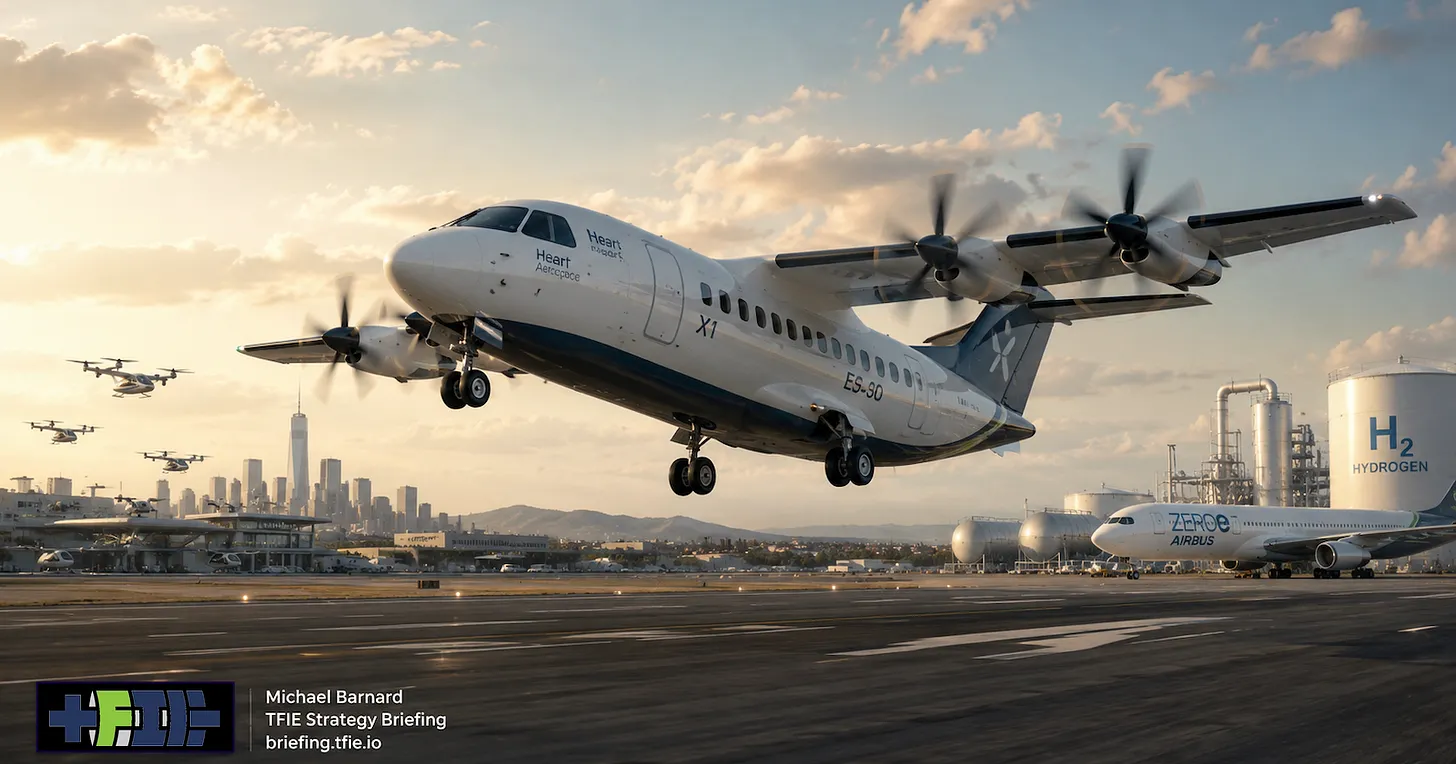
Heart Aerospace conducted a 27-minute test flight of its X1 demonstrator aircraft on August 12 from Plattsburgh International Airport in New York, marking what the company claims represents the largest battery-electric aircraft ever flown. The aircraft, featuring a 106-foot wingspan and weighing more than 25,000 pounds at takeoff, drew more than one megawatt of power at peak consumption during the flight. This test represents a concrete engineering milestone for electric aviation technology as the sector pursues alternatives to fossil fuel combustion in commercial aviation.
Aviation accounts for approximately 2.5 percent of global carbon dioxide emissions. Reducing this footprint requires moving beyond incremental efficiency improvements in kerosene-powered engines toward fundamental propulsion shifts. Battery-electric propulsion offers one pathway. Hydrogen fuel cells represent another. Sustainable aviation fuels provide a near-term interim solution. Heart Aerospace's demonstrator targets the battery-electric segment, which faces distinct engineering constraints that the X1 flight begins to address.
The primary challenge confronting battery-electric aviation remains energy density. Lithium-ion batteries, the current standard in aviation testing, store roughly 250 watt-hours per kilogram. Jet fuel contains approximately 11,000 watt-hours per kilogram. This density gap means battery-electric aircraft cannot match traditional aviation's range and payload capacity with current technology. Successful electrification requires either breakthrough battery innovations, operational model changes accepting shorter routes with frequent charging cycles, or hybrid architectures combining batteries with alternative power sources.
Heart Aerospace's approach incorporates electric propulsion paired with range-extension technology, though the August flight relied entirely on batteries. The X1's 27-minute duration and weight specifications suggest the aircraft operates within parameters demonstrating feasibility rather than commercial viability. Commercial aviation requires multi-hour flights at altitude with payload capacity. Testing shorter duration flights with smaller loads establishes technological proof-of-concept that feeds into longer-term development timelines.
The aviation sector requires sustained investment to transition toward electrification. Aircraft manufacturers including Airbus and Bombardier have announced electric commuter aircraft programs targeting regional routes. Eviation, Heart Aerospace's competitor, conducted a similar battery-electric flight test in 2022 with its Alice aircraft. Pipistrel aircraft has certified an electric trainer aircraft for flight instruction. These parallel efforts indicate expanding industry momentum rather than isolated demonstrations.
The financial implications extend across supply chains. Battery manufacturers must scale production of aviation-grade cells. Charging infrastructure requires deployment at regional airports. Aircraft maintenance training programs require updating. Grid capacity at airport facilities requires expansion. These systemic changes demand billions in cumulative capital allocation across multiple sectors over the next decade.
Regulatory approval timelines also matter. The Federal Aviation Administration must develop certification standards for electric aircraft. European Union Aviation Safety Agency follows similar processes in European airspace. These regulatory developments occur slowly, typically spanning years from initial guidance release through type certification. Heart Aerospace's test flight provides data that informs these ongoing regulatory discussions.
The X1 demonstrator flight signals technical progress on battery-electric aviation's engineering challenges. Whether this translates into commercially deployed aircraft within the next five years depends on battery technology acceleration, regulatory approval speed, and investor capital availability for manufacturing scale-up. The test establishes feasibility. Converting feasibility into operational commercial service remains the unresolved challenge.