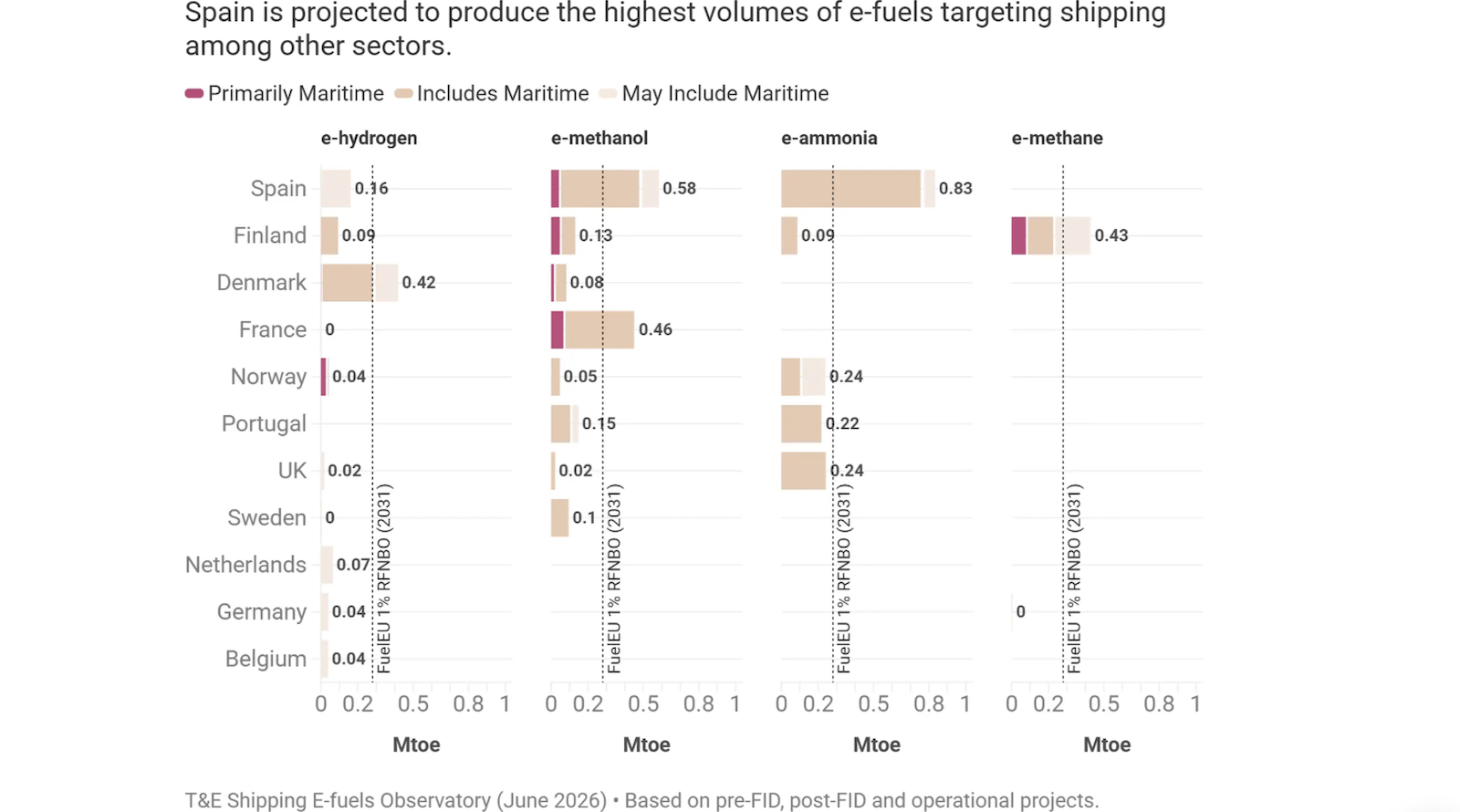
Europe has 69 e-fuel projects designed to supply zero-emission fuels for maritime shipping, yet only six operate commercially today. This gap between planned capacity and actual production threatens European competitiveness against China in the global green shipping fuel market, according to Transport and Environment (T&E).
E-fuels, produced by combining hydrogen with captured carbon dioxide, offer one pathway to decarbonizing shipping without requiring vessel redesigns. The International Maritime Organization requires the sector to cut greenhouse gas emissions by 50 percent by 2050 compared to 2008 levels. E-fuels could help meet this mandate, but Europe's slow deployment undermines its position as a technology leader.
Only 9 percent of Europe's announced e-fuel projects have reached operational status. The remaining 63 projects exist as proposals or early-stage development. This stagnation reflects financing barriers, regulatory uncertainty, and the capital intensity of production infrastructure. China, by contrast, has accelerated deployment of competing green shipping fuel technologies and manufacturing capacity.
T&E's analysis identifies regulatory measures as critical to unlocking growth. The EU could mandate minimum blends of zero-emission fuels in marine bunkers, similar to requirements for road transport fuel. Such mandates would create market certainty and justify the billions in investment required for production facilities.
Europe's Refueling Europe regulation and the broader Green Deal framework emphasize maritime decarbonization, yet implementation timelines lag behind technology readiness. The pathway to commercial viability by 2033 requires immediate action to move projects from planning into construction and operation.
Competitive advantage depends on moving faster. China's industrial capacity advantage in hydrogen and synthetic fuel production, combined with aggressive state support for manufacturing, positions it to dominate e-fuel supply chains if Europe maintains current deployment rates. European shipowners increasingly source from non-European suppliers as local options remain limited.
Acceler