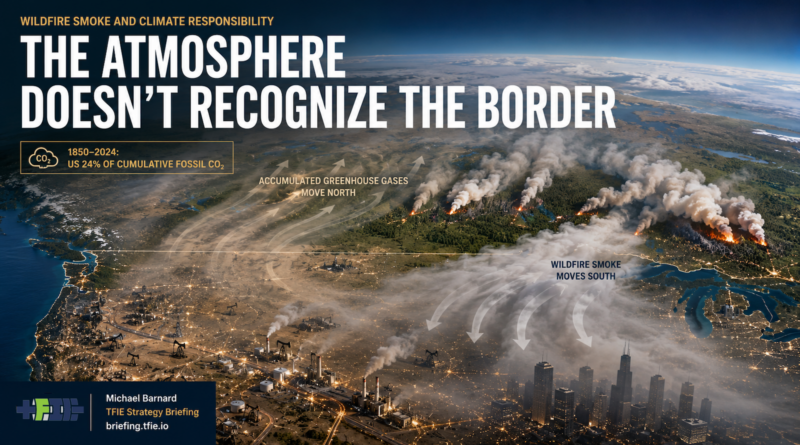
President Trump has blamed Canada for wildfire smoke crossing U.S. borders, demanding Prime Minister Mark Carney control the fires, seek compensation, and threatening tariffs in response. While smoke from Canadian wildfires did drift into American cities, the underlying cause reflects a climate crisis shaped significantly by U.S. emissions patterns.
Wildfire intensity and frequency across North America have intensified as warming temperatures dry vegetation and extend fire seasons. Scientific data from the National Interagency Fire Center documents a sharp rise in large fires over the past two decades, directly correlating with climate warming. The United States contributes roughly 13 percent of global greenhouse gas emissions, making it the second-largest emitter after China. This accumulated warming has altered precipitation patterns and soil moisture across the continent, conditions that increase fire vulnerability in both countries.
Canada faces genuine wildfire challenges. The 2023 and 2024 fire seasons saw record acreage burned, with smoke reaching major U.S. cities including New York and Washington, D.C. However, attributing smoke events solely to Canadian management overlooks the climatic conditions driving the fires themselves. The warming trend that extends fire seasons originates from global emissions, with the U.S. share historically outsized.
Trump's approach sidesteps the emissions reduction mechanisms outlined in climate science. The Intergovernmental Panel on Climate Change documents that limiting warming to 1.5 degrees Celsius requires immediate cuts to fossil fuel use. His threatened tariffs on Canadian goods would not address fire behavior or atmospheric circulation patterns; it represents a punitive approach to a shared environmental problem.
Canada does manage its forests, though wildfire suppression becomes increasingly difficult under changing climate conditions. Provinces allocate substantial budgets to firefighting, yet extreme weather events overwhelm existing capacity. The smoke that crossed into U.S. airspace resulted from fires burning under atmospheric conditions that favor smoke transport