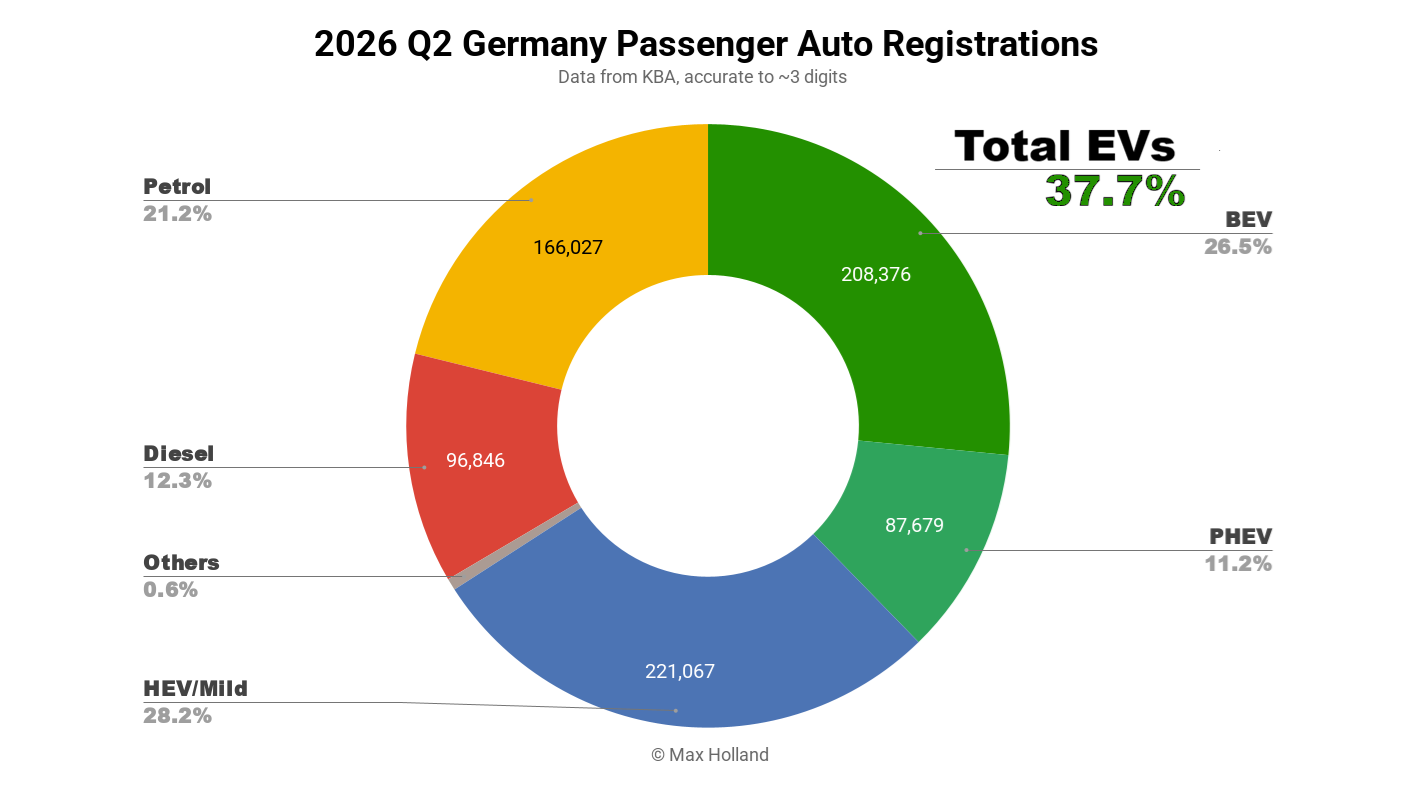
Germany's plug-in electric vehicle market share surged to 37.7% in the second quarter of 2026, jumping nearly 10 percentage points from 28.6% in the same period last year. Battery electric vehicles (BEVs) drove this expansion, while plug-in hybrids (PHEVs) grew at a slower pace.
The German auto market sold 784,989 vehicles in Q2 2026, representing a 6% increase year-over-year. This growth reflects accelerating electrification across Europe's largest economy, where EV adoption has become a defining market trend.
Tesla's Model Y dominated the BEV segment, claiming the best-selling position among battery-only vehicles. This reinforces Tesla's continued grip on the German premium EV market, despite intensifying competition from legacy automakers expanding their electric lineups.
The data tracks a broader European pattern. Germany, home to Volkswagen, BMW, and Mercedes-Benz, has become a crucial battleground for EV transition. National targets under the EU Green Deal and Germany's own climate commitments have created regulatory pressure on traditional manufacturers to accelerate electrification while new entrants like Tesla capture market leadership positions.
BEVs remain the growth engine. Their rapid expansion outpaced PHEVs, which typically appeal to buyers seeking a combustion engine backup. This shift reflects improving charging infrastructure and rising consumer confidence in battery range and reliability, factors that have historically deterred BEV adoption.
The 37.7% share milestone places Germany among Europe's EV leaders, though still behind Norway, which maintains over 90% EV market share. Germany's trajectory demonstrates how policy support, manufacturing capacity, and consumer acceptance converge to reshape automotive markets. The data also underscores Tesla's ability to capture first-mover advantage in a market where domestic competitors once