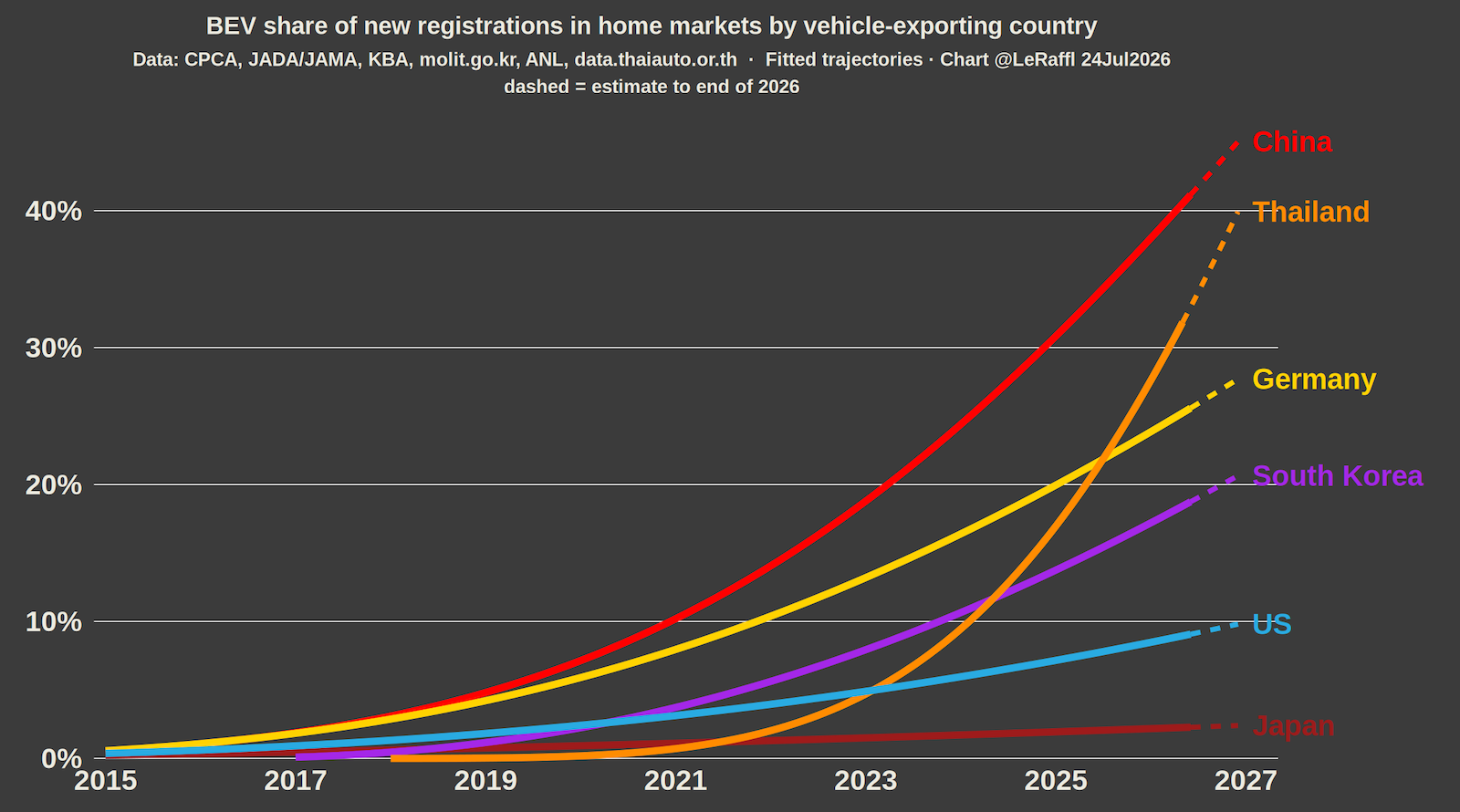
China's domestic electric vehicle policy is reshaping the global automotive hierarchy faster than international trade dynamics, with Thailand emerging as an unexpected rival by adopting similar strategies.
Beijing's latest NEV (new energy vehicle) plan establishes ambitious targets for EV adoption within China's domestic market. This inward focus proves more consequential for global competition than export-oriented approaches. By securing massive domestic demand first, Chinese manufacturers build production scale, supply chain integration, and cost advantages that translate to export competitiveness.
Thailand has adopted this model with efficiency. The Southeast Asian nation is replicating China's playbook by incentivizing domestic EV manufacturing and consumption through targeted subsidies and regulatory requirements. Thailand's automotive sector already attracts major Chinese manufacturers seeking production bases outside China, positioning the country to capture regional EV leadership.
The policy shift reflects a fundamental principle: nations that dominate their home markets establish the technological standards, battery supply chains, and manufacturing infrastructure that determine export success. China controls rare earth processing, battery cell production, and semiconductor supplies for EVs. These advantages flow from domestic policy decisions prioritizing vertical integration over free-market competition.
China's carbon-peaking targets mandate accelerated EV adoption, which forces automakers to invest heavily in electric powertrains. Manufacturers that succeed domestically gain the capital and expertise to compete internationally.
Thailand's strategy focuses on becoming a regional hub. The country offers Chinese manufacturers lower labor costs and preferential trade access to ASEAN markets. Thai policy prioritizes EV assembly and battery component production, avoiding direct competition with China while building authentic industrial capacity.
Traditional auto powers like Germany and the United States pursued export-first strategies, assuming global market dominance would follow. This approach underestimated how domestic policy shapes competitive advantage. Germany's EV transition remains constrained by legacy internal combustion engine commitments. America's fragmented state-level policies create inefficiency compared to China's