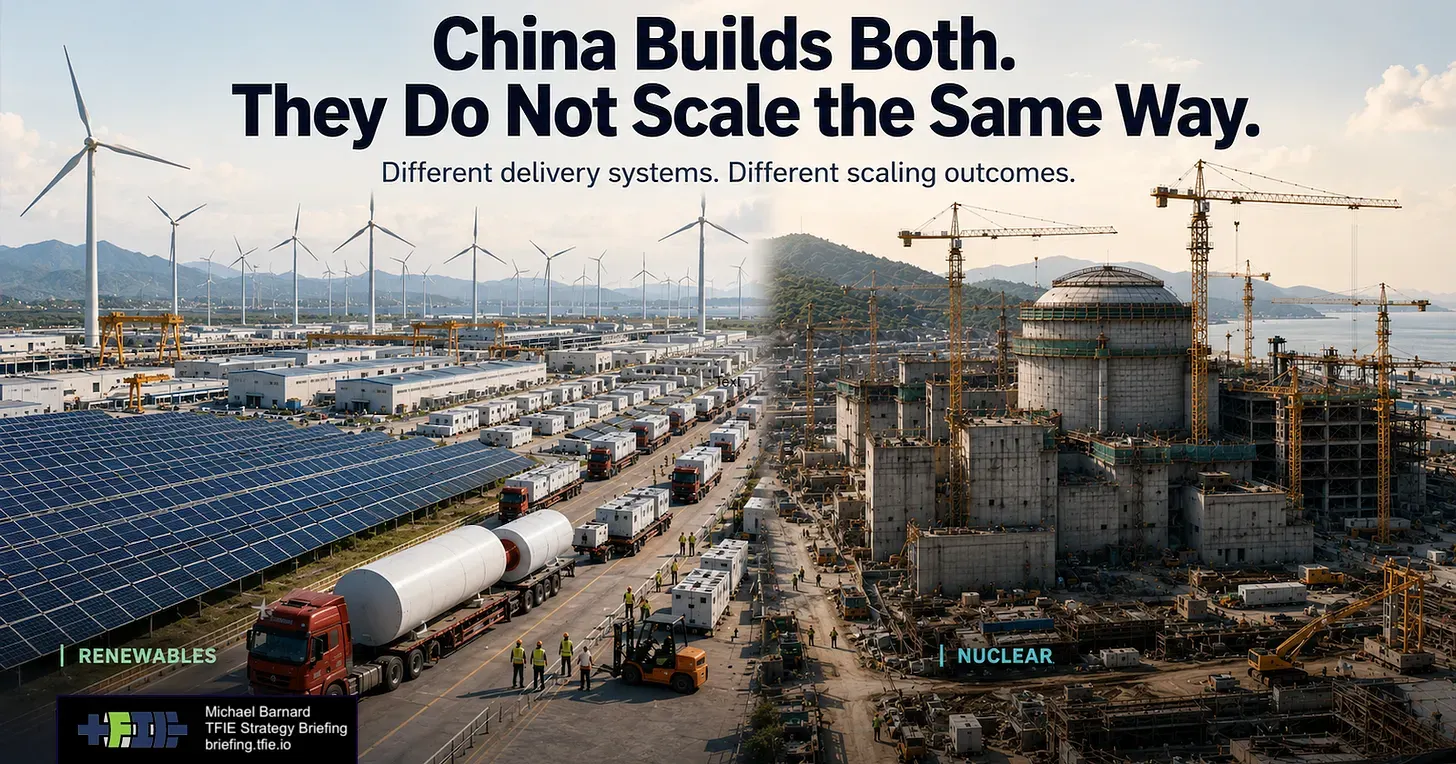
China's renewable energy capacity has repeatedly surpassed official targets, sometimes by years, while nuclear power goals consistently fall short despite government backing and ongoing construction. This divergence reveals fundamental differences in deployment speed between technologies.
Wind and solar installations have expanded faster than projections anticipated. China's National Energy Administration set targets for renewable capacity additions, but the actual buildout has outpaced these benchmarks. Solar deployment particularly accelerated, with installations exceeding forecasts by substantial margins in recent years. Manufacturing capacity, supply chain efficiency, and cost reductions in photovoltaics and wind turbines enabled rapid scaling beyond what planners expected.
Nuclear capacity targets tell a different story. Despite political commitment, regulatory approvals, and active construction sites, China's operating nuclear fleet has grown slower than planned. Reactor construction timelines face delays from engineering challenges, supply chain constraints, and safety reviews. Commissioning new plants takes longer than initial schedules project. The gap between approved reactors and operational capacity has widened, creating a backlog between planning and delivery.
These patterns matter for energy policy. When forecasts treat renewable and nuclear targets as interchangeable statements about decarbonization, they misrepresent the actual pace of deployment. Renewable targets provide realistic benchmarks because installation speed matches or exceeds estimates. Nuclear targets function differently. They reflect aspirations rather than demonstrated delivery rates.
China's total clean energy capacity continues growing. Grid integration of variable renewables requires ongoing investment in transmission, storage, and grid flexibility. Nuclear plants provide reliable baseload power but operate on longer development cycles.
For forecasters and policymakers, the lesson is concrete. Projections should anchor to historical performance, not abstract targets. China's renewable track record demonstrates that solar and wind can scale faster than conventional planning models suggest. Nuclear timelines require more conservative estimates based on actual construction and commissioning rates.
The divergence reflects technology-specific realities