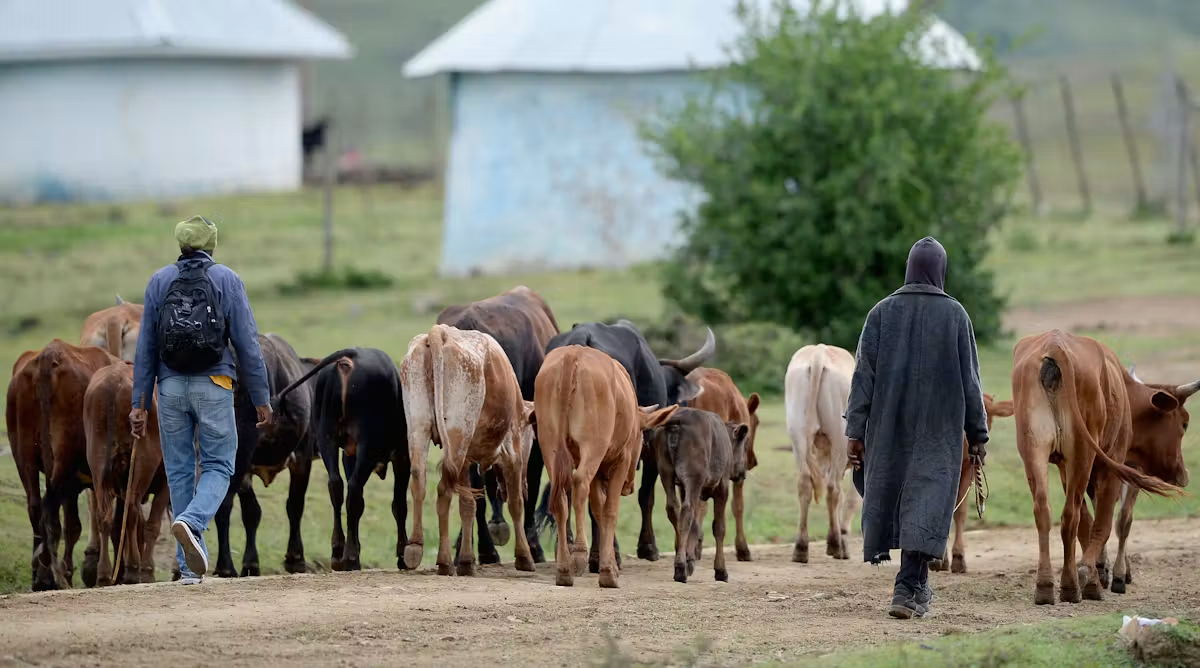
South Africa's roughly 613,000 smallholder cattle farming families manage about 40 percent of the national herd. These farmers operate on shared rangelands and depend on December's summer rains to refill water sources and restore grazing land. A super El Niño is forecast to bring extreme heat and severe drought during this critical season.
Rising temperatures cause water to evaporate rapidly and soil to dry. Shared rural dams can fail quickly. Without rain, grazing becomes less nutritious. Livestock can die from heat stress without adequate water and feed.
Researchers studying climate change and livestock systems in South Africa conducted two studies on communal feedlots, which are shared enclosures where farmers temporarily house livestock for feed, water, shade and veterinary care during droughts or extreme heat. The first study found that shade and water cooling in South African communal feedlots reduced heat stress and helped animals gain weight. The second study found that community-run feedlots were better at coping with drought and involving local farmers, while commercial feedlots fattened cattle faster.
Past emergency feed deliveries were slow, costly and did not reach all farmers in need. Animals still died. The researchers say governments and organizations need to establish community-based communal feedlots now by retrofitting existing village kraals with shade cloth and water tanks. Provincial agricultural departments and local farming cooperatives can pool funds to buy feed.
Research at the Gxwalibomvu Custom Feeding scheme in Tsomo and the Transkei Feed Kraal in Centane found these hubs relieved pressure on grasslands and helped smallholders sell cattle at premium prices rather than distressed prices. Research found that shade and water spraying lowered animal body temperatures, improved daily weight gain by 18 percent, and increased feeding efficiency by 12 percent compared to uncooled cattle. Indigenous breeds like Nguni cattle handled heat better than imported European breeds.
Zimbabwe has set up hundreds of "drought mitigation centres" to feed and supply water to 2.2 million cattle during the coming super El Niño.
The researchers recommend training agricultural advisers in kraal microclimate design, funding solar-powered boreholes and shade nets, training farmers in animal nutrition and heat stress measurement, and introducing index insurance that pays automatically when local temperatures rise too high or grazing falls below a set level.