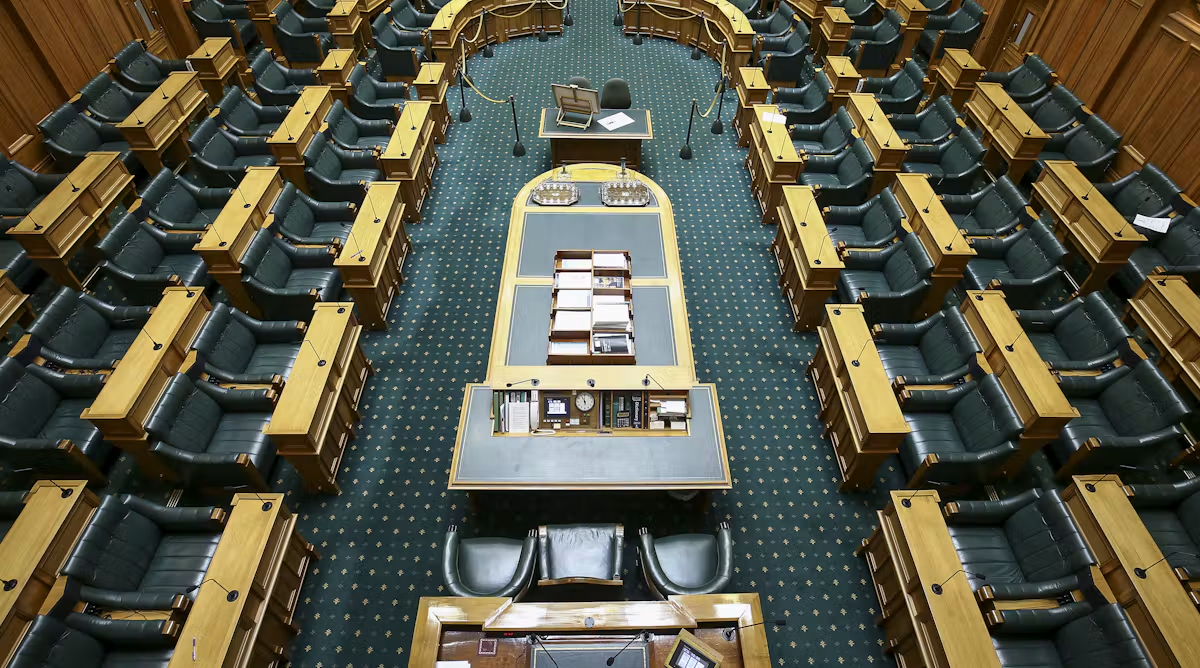
Based on provisional election results, New Zealand's parliament could grow by up to 11 overhang seats without accurately representing the proportion of party votes cast. Overhang seats are added when a party wins more electorates than its party vote share entitles it to hold.
New Zealand adopted the mixed member proportional (MMP) electoral system after the 1993 referendum. Voters cast two votes: one for a party and one for an electorate candidate. The party vote is intended to shape parliament's overall composition by topping up seats from party lists after electorate contests are determined.
In 1986, the Royal Commission on the Electoral System recommended a 60 to 60 ratio of list seats to electorate seats. Parliament instead created 65 electorate seats and 55 list seats for the first MMP election in 1996. The ratio was not fixed because the number of general electorate seats was set to maintain 16 seats in the South Island. By the 2020 election, there were 72 electorate seats and only 48 list seats. In 2026, the number of electorate seats decreased slightly to 71 and list seats rose to 49.
The Electoral Act acknowledges that parties might win more electorate seats than their party vote entitlement. When this occurs, the number of list seats rises, but the calculation to ensure proportionality remains based on a 120-seat parliament. The Green party was assigned 16 seats on a party vote of 13.3 percent. In a 131-seat parliament resulting from the 11-seat overhang, the Greens' seat share represents only 12.2 percent. A baseline of 131 seats would give the Greens an extra seat but increase parliament's total size to 132.
Germany adopted a similar MMP system and encountered this problem as votes for smaller parties rose and larger parties fell, making overhangs more prevalent. Germany's constitutional court required an amendment to more fully compensate for overhang. But this led to a huge increase in the Bundestag. In 2023, Germany amended the law again to cap the house size and simply exclude candidates elected in overhang seats, leaving those electorates unrepresented.
Two reviews of New Zealand's MMP system recommended abolition of overhang seats. The 2012 Electoral Commission's review and the 2023 Independent Electoral Review Committee both proposed retaining parliament at 120 seats even if parties gained more electorate seats than entitled by their party vote. The number of list seats would go down, further reducing their compensatory role.
An increase in the number of list seats would go part way to addressing the problem. National's overhang of about seven seats would probably be almost gone if there were 140 seats in parliament, with matching electorate and list seats of 70 each.
Germany's solution almost completely destroys incentives for pursuing overhang but means some electorate candidates initially elected on low vote shares don't sit in parliament and their electorates are not directly represented. A more dramatic solution would fuse party and electorate votes into a one-vote system, but this would eliminate the ability to distinguish between a local MP and the party they represent.