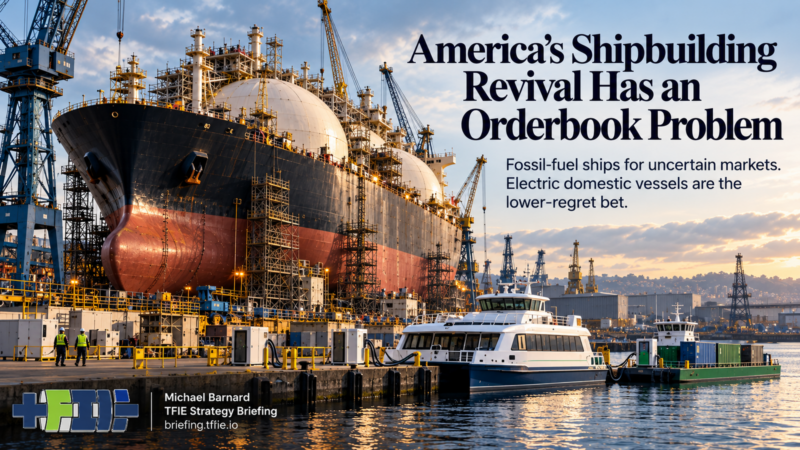
South Korea's Hanwha Group acquired the Philadelphia shipyard in December 2024, giving it control of a facility the U.S. government views as central to rebuilding American commercial shipbuilding. The acquisition brings shipbuilding expertise and technology transfer to U.S. workers while maintaining South Korean corporate ownership.
Hanwha's orderbook reveals a challenge to independent commercial viability. The company has ordered two liquefied natural gas carriers, four oil and chemical tankers, and options for six additional tankers. Most of these orders come from Hanwha's own shipping affiliates rather than independent shipowners. Three LNG-fueled container ships ordered by Matson in 2022 predate current administration efforts.
The cost gap between American and foreign shipbuilding remains steep. Kinder Morgan's January 2026 investor presentation estimates a new medium-range Jones Act tanker would cost more than $240 million and require daily charters above $115,000 to justify construction. The existing charter market operates around $90,000 per day. Kinder Morgan operates 16 fully utilized tankers but the gap between current charter revenue and replacement vessel costs remains substantial.
Coastal petroleum shipping also faces competition from other domestic infrastructure. A 2025 report to the Commodity Futures Trading Commission estimated moving gasoline from Houston to New York Harbor costs under 8 cents per gallon by pipeline, about 20 cents by ship, and roughly 35 cents by rail. Tankers remain essential where pipelines are unavailable but cannot compete on price where alternatives exist.
The International Energy Agency estimates electric vehicles displaced 1.7 million barrels of oil per day worldwide in 2025 and could displace about 5 million by 2030 under policy scenarios. This trend affects long-term tanker demand over several decades.
LNG export carriers face different prospects. U.S. gas exports may expand and require LNG tankers to carry them. The test for U.S.-built LNG carriers is whether independent buyers will choose Philadelphia-built ships against established Korean, Japanese and Chinese yards once internal affiliate demand and cargo preference requirements are removed.
The Great Lakes domestic vessel market already operates at scale. U.S.-flag Great Lakes freighters carried 71.3 million tons in 2025, much of it iron ore, limestone, cement and coal. Ferry services, harbor vessels and inland cargo craft require vessel renewal as well. Battery-electric and hybrid-electric propulsion offer practical options on routes with manageable energy requirements and reliable charging access.
Washington State's three new hybrid-electric ferries carry a $714.5 million shipbuilding contract with total program expenses estimated at approximately $1.15 billion. Construction has started; the ferries are not yet in service. Electrification alone does not cure American shipbuilding cost problems. The path to a productive shipbuilding industry requires standardized designs, modular fabrication, trained workers, repeat orders, reliable delivery and falling labor-hours per vessel.
Hanwha's progress should be measured by independent repeat customers, improving construction costs and commercially competitive vessels rather than affiliated orders or investment announcements.