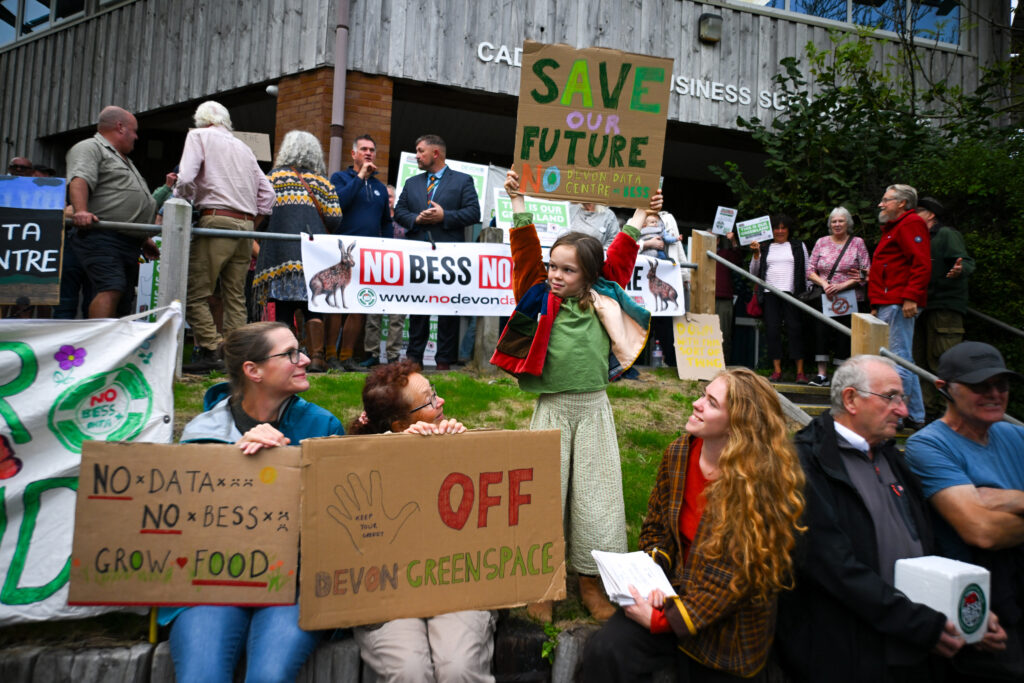
Microsoft plans a 140-megawatt data center in Slough, which already hosts over 40 data centers and is Europe's data-center capital. Residents including scientist Ambily Banerjee have begun opposing the expansion, questioning what benefits the boom brings to the borough while residents bear the risks.
Opposition to data centers entered electoral politics in the 2026 U.S. midterms, where 56 percent of voters said data centers were a major or crucial factor in congressional choices, according to Wall Street Journal polling.
Britain's Labour government has set out to triple data center capacity by decade's end, dismissing the Green Party's proposed moratorium as "a disaster for jobs and national security." An investigation by Spotlight on Corruption found that ministers consulted 137 businesses on expansion but just two community groups and no environmental organizations. Government estimates of the sector's energy demands have differed by as much as tenfold, according to The Guardian.
The U.K. is the third-largest AI market globally after the U.S. and China, with around 500 data centers across the country. As of the end of 2025, 90 percent were sited in England, with London accounting for nearly two-thirds of the national total.
Chancellor John Healey's October 28 budget announced a British Data Centre Covenant offering developers faster grid access in exchange for commitments to use only requested capacity, invest in clean power and net zero, deliver local benefits, and meet environmental standards.
Ofgem, the U.K.'s energy regulator, reported 315 hyperscale data center projects awaiting grid access, accounting for 73 gigawatts of demand connection requests. Peak national demand in 2025 was around 45 gigawatts.
The government launched an AI Growth Zones program to steer facility locations to areas with better power access. Five zones have been announced in the past year. The government proposes electricity-cost discounts taking effect in April 2027, potentially saving a 500-megawatt facility around $32 per megawatt-hour in Scotland, $21 in Cumbria and $18 in the North East.
Local authorities in England's AI Growth Zones will retain 100 percent of additional tax revenue from new data center development for 25 years.
BloombergNEF expects installed data center capacity across Europe, the Middle East and Africa to reach 53.1 gigawatts by 2035, up from 19.2 gigawatts in the first quarter of 2026. The U.K. is projected to account for around 14.5 percent of that.