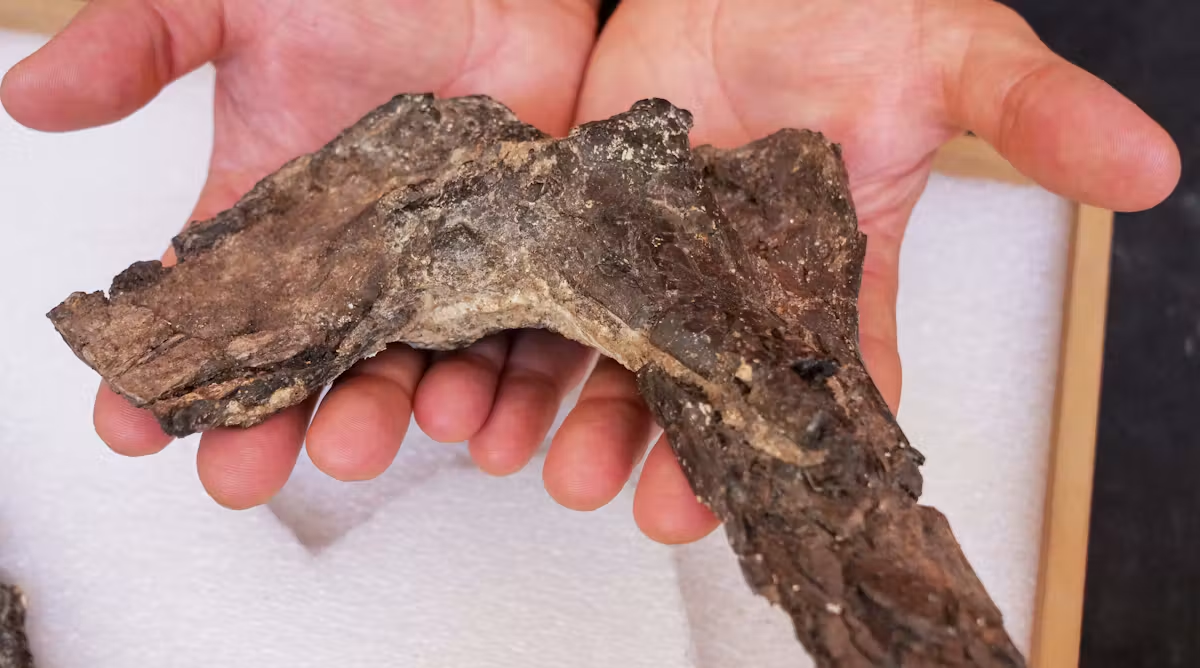
A 115-million-year-old dinosaur fossil from Brazil contains structures resembling red blood cells and molecular traces of blood, according to research published today in the Proceedings of the National Academy of Sciences. This marks the first direct molecular evidence of blood compounds preserved within structures that look like red blood cells.
The fossil is a partial hind limb of a small dinosaur called Aratasaurus museunacionali, found in the Romualdo Formation in northeast Brazil. The specimen is now housed at a paleontology museum in northeast Brazil. It was in the National Museum until a 2018 fire, though the building holding this fossil was not affected.
Researchers from Brazil, Japan and the United States found the structures exclusively within vascular canals inside the bone, where red blood cells are located in living vertebrates. The surrounding sediment contained none of these structures, making external contamination unlikely.
Analysis identified two chemical "fingerprints" of blood with the structure of heme molecules, a key component of hemoglobin. The fossil bone contained a distinct signature dominated by heme molecules, while the surrounding sediment mostly contained compounds from plant and bacterial sources.
The dinosaur was rapidly buried in a low-oxygen environment that slowed decay. Minerals such as hausmannite may have acted as antioxidants, stabilizing organic molecules and slowing their breakdown. During fossilization, microscopic red blood cells turned into minerals.
The fossil red blood cell-like structures appear larger and more rounded than cells found in modern birds and crocodilians. Researchers cannot yet determine whether this difference resulted from deformation during fossilization or reflects actual differences in dinosaur blood cells.