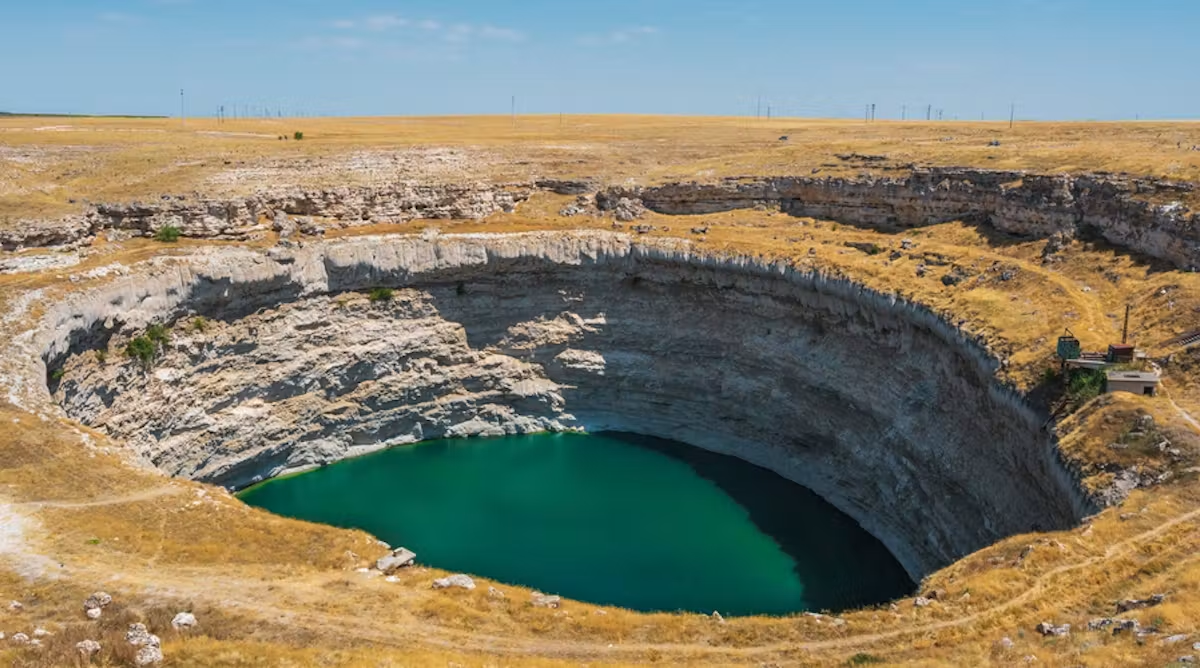
Turkey's central Anatolian plateau is experiencing an escalating sinkhole crisis. The nation's disaster and emergency management authority (AFAD) has documented 684 sinkholes across Konya, Karaman and Aksaray. Around 20 open up every year, according to a recent study.
Known locally as obruks, these geological features have existed in the Konya basin for thousands of years. Their recent frequency marks a sharp change. A study tracking sinkhole formation between 2000 and 2024 found the annual formation rate jumped from approximately three sinkholes during 2000-10 to 32 during 2016-19. The rate subsequently declined to around 22 a year after 2020.
The cavities form through karstification, a process in which groundwater circulating through fractures dissolves minerals in carbonate rocks like limestone and enlarges openings. Sinkholes develop when the material above these voids becomes unstable.
Groundwater depletion accelerates their collapse. Decades of intensive agricultural irrigation have altered the basin's hydrogeology. A recent regional study estimated an average annual loss of groundwater storage equivalent to 3.4 centimetres of water. As underground water levels fall, pressure within rock pores and fractures decreases, destabilizing existing cavities. Lower groundwater also changes water and sediment movement through cavities, allowing loose material to shift downward.
Turkey experienced its most severe drought for decades in 2025. Farmers often respond to water stress by extracting more groundwater, intensifying the problem.
The basin also experiences land subsidence, in which the ground gradually sinks as sediments compact. Satellite radar measurements revealed widespread subsidence of up to 90 millimetres per year.
Konya is a closed drainage basin, meaning water does not flow toward the sea but accumulates underground or evaporates. Rainfall is relatively low and falls largely outside the main growing season, making groundwater indispensable for irrigated crops including maize, sugar beet and fodder.
The demand for water has grown beyond aquifer recovery rates. Agricultural policies have favored high production levels rather than water conservation. Restricting groundwater extraction without farmer support could impose substantial economic pressure and threaten food supply. Yet continued depletion could progressively undermine the agricultural production that made the region economically important.
A long-term response would require reliable monitoring of groundwater levels and withdrawals, enforceable extraction limits, agricultural incentives aligned with local water availability and detailed mapping of geological hazards.