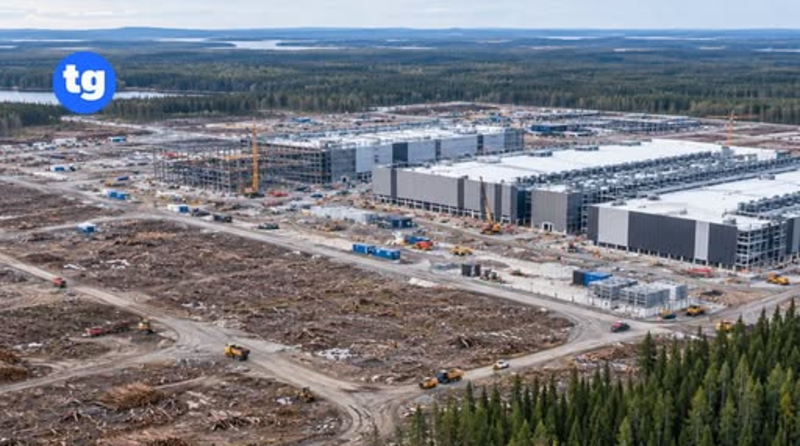
Google is clearing approximately 250,000 trees in Finland to construct a massive data center, a project that raises urgent questions about the environmental cost of digital infrastructure expansion and the adequacy of carbon accounting in the tech industry.
The company plans to fell the trees across a large tract of Finnish forest to make way for a new facility that will house servers and computing equipment. Finland's forests represent some of Europe's most productive carbon sinks, with boreal forests sequestering significant amounts of atmospheric carbon each year. The removal of a quarter-million trees eliminates that carbon-storage capacity and releases stored carbon back into the atmosphere through logging and decomposition.
Data centers consume enormous quantities of energy. Google's Finnish facility will require reliable power generation to operate servers continuously. While Google has committed to powering its operations with renewable energy, the immediate environmental trade-off remains stark: a functioning forest ecosystem swapped for an industrial computing facility.
Finland has become a focal point for data center development in northern Europe. Tech companies favor the region for its cool climate, which reduces cooling costs for servers, and its abundant renewable energy resources, particularly hydropower. However, this concentration of development pressures Finland's forest resources. The country's forests cover roughly 70 percent of its land area, yet logging rates have accelerated to meet both traditional timber demand and new infrastructure projects.
The carbon accounting becomes complex. Proponents argue that the data center's renewable energy sourcing and efficiency improvements offset the immediate forest loss over time. They point to life cycle analyses suggesting that internet infrastructure reduces overall emissions by enabling remote work, digital services, and efficiency gains elsewhere in the economy. However, critics counter that this reasoning rationalizes habitat destruction and carbon release today in exchange for speculative future benefits.
Finnish environmental organizations have raised concerns about the project's impact on biodiversity. Boreal forests support distinct ecosystems with specialized species adapted to old-growth conditions. Clear-cutting disrupts these habitats and fragments forest landscapes, affecting wildlife migration patterns and breeding grounds. Replanting monoculture timber plantations does not restore the ecological complexity of natural forests.
The project also highlights tensions between Finland's climate commitments and economic development priorities. Finland targets carbon neutrality by 2035, yet approving large-scale deforestation appears inconsistent with that goal. The country's forest-based carbon sequestration remains central to its climate strategy, making tree loss particularly consequential for meeting national emissions targets.
This situation extends beyond Finland. Amazon deforestation for data centers, server farm expansion in sensitive ecosystems, and the material demands of digital infrastructure collectively represent a growing environmental footprint rarely tallied in discussions of tech sector sustainability. Google and other hyperscalers frame renewable energy sourcing as their primary environmental commitment, yet they gloss over land-use impacts that carry long-term ecological consequences.
The Finnish project exemplifies how the transition to digital infrastructure can displace rather than eliminate environmental costs. Moving computation to renewable-powered facilities improves energy efficiency in that narrow sense, but purchasing forested land for development simply relocates the carbon debt elsewhere on the landscape.