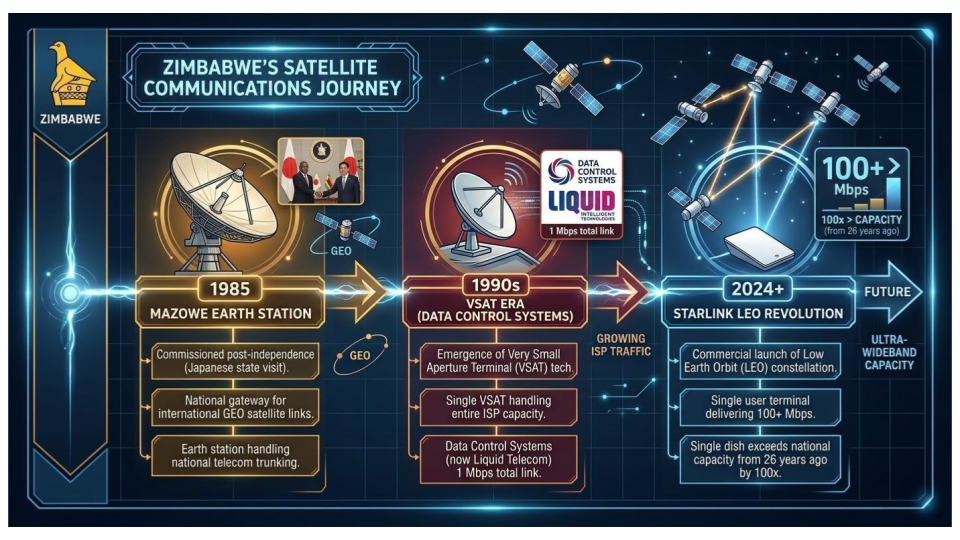
Zimbabwe is developing a twelve-month roadmap to integrate Starlink's low-earth orbit satellite constellation with the country's existing terrestrial fiber optic network. The plan centers on establishing domestic gateway teleports, securing Q/V band licenses, and creating a Point of Presence hub in Harare.
The integration strategy addresses a persistent infrastructure gap in southern Africa. Zimbabwe's satellite telecommunications history traces back to a state visit to Japan that catalyzed the nation's first major satellite projects. The evolution from those early systems to modern low-earth orbit constellations reflects broader regional shifts toward hybrid connectivity models.
Starlink's LEO constellation offers Zimbabwe immediate bandwidth access without waiting for terrestrial fiber expansion into rural areas. The network operates at altitudes of 550 kilometers, enabling lower latency than traditional geostationary satellites. This technology gap matters for applications ranging from telemedicine to agricultural extension services across Zimbabwe's interior regions.
The roadmap's three technical pillars work in concert. Domestic gateway teleports serve as physical ground stations where signals transition between Starlink's satellites and Zimbabwe's fiber backbone. These facilities require investment in antenna arrays, power systems, and cybersecurity infrastructure. Q/V band licensing refers to the regulatory authorization for frequencies around 38-50 gigahertz, which offer higher data rates than currently deployed Ku or Ka bands but require more precise engineering.
The Harare Point of Presence represents the network's network operations center. From this hub, traffic routing decisions direct data between satellite and fiber routes depending on demand and availability. This hub also handles authentication, billing, and monitoring functions for the integrated system.Zimbabwe's telecommunications regulator must approve these technical specifications. The country's postal and telecommunications regulatory authority previously issued spectrum guidelines favoring both satellite and terrestrial operators, creating space for hybrid models. However, implementing Q/V band operations requires new equipment procurement, site surveys, and staff training.
The twelve-month timeline reflects realistic project phases. Initial months cover regulatory submissions and site acquisition. Mid-period phases involve equipment installation and network testing. Final phases emphasize redundancy checks and handover to operational teams.
Financing remains unresolved in publicly available statements. Gateway teleports cost between $5 million and $15 million depending on scale and redundancy levels. Zimbabwe's government has explored partnerships with international development banks, though details remain preliminary.
The integration approach contrasts with pure satellite-only or fiber-only strategies. Hybrid models reduce rural access costs while maintaining backbone quality through fiber in urban corridors. This makes economic sense for a lower-middle-income country with dispersed population centers.
Neighboring countries including South Africa and Botswana pursue similar hybrid strategies. Regional coordination on frequency sharing and gateway routing could reduce costs through economies of scale, though such coordination requires bilateral agreements still under negotiation.
The roadmap's success hinges on sustained political commitment beyond the initial twelve months. Telecom infrastructure projects frequently encounter delays in permitting, equipment import customs clearance, and workforce availability. Zimbabwe's history with infrastructure projects shows variable execution rates depending on foreign exchange availability and staff retention.