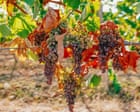
France's wine industry faces its worst harvest in three decades. The agriculture ministry projects production of just under 34 million hectolitres for 2024, marking a 6 percent decline from 2023 and a 17 percent drop from the 2021-2025 average. This collapse stems directly from France's hottest summer on record, paired with severe drought conditions across major wine regions.
The numbers reveal an industry under acute climate stress. Heat and water scarcity have reduced grape yields across Bordeaux, Burgundy, the Rhone Valley, and other critical appellations. Vineyards face not only reduced volume but also quality threats. Wildfire smoke, a secondary disaster linked to the extreme heat, poses a "smoke taint" risk that can render grapes undrinkable by imparting unpleasant flavors to finished wines.
French winemakers worry about both immediate economic losses and long-term viability. A 30-year low production signals a structural shift, not merely a cyclical downturn. France produces roughly one-fifth of the world's wine. When French output contracts this sharply, global wine supplies tighten and prices rise for consumers and buyers worldwide.
The drought problem extends beyond 2024. Soil moisture deficits accumulated over months of below-average rainfall. Grapevines require consistent water access during critical phenological stages: flowering, fruit set, and veraison (color change). When water stress coincides with extreme heat, vines cannot transpire effectively, canopy photosynthesis declines, and grape sugars and phenolic compounds (which determine wine quality) fail to develop normally.
Climate data supports the winemakers' alarm. Summer 2024 broke French temperature records, with multiple heatwaves pushing thermometers well above historical norms. The European Environment Agency has documented accelerating heat extremes across the continent. For wine regions, even slight temperature increases compress the already-narrow window for optimal ripening. Conversely, water availability has declined as Mediterranean and Atlantic weather patterns shift.
The wildfire component adds complexity. Smoke exposure during ripening imparts volatile compounds that survive fermentation and aging. Even small quantities of smoke taint render wine commercially worthless. French firefighting efforts in July and August prevented some worst-case scenarios, but smoke dispersal across vineyards occurred nonetheless.
Winemakers face immediate decisions: harvest early to avoid further heat damage and smoke exposure, or wait and risk total crop loss. Early harvesting yields less mature fruit with lower sugar content and harsher tannins. Late harvesting gambles on weather stability and wildfire containment. Many producers split the difference, harvesting in tranches across several weeks.
Economic ripple effects will reach retailers and consumers within months. Wine inventories are finite. Producers will prioritize premium bottlings over entry-level wines, squeezing affordable options from shelves. Prices for 2024 vintage French wines will climb sharply. Importers and distributors will seek substitutes from Spain, Italy, Australia, and the United States, reshaping purchasing patterns.
This crisis reflects a broader vulnerability in European agriculture. Viticulture spans centuries in France and relies on stable, familiar climate conditions. Rapid warming and drought stress expose the fragility of that system. Unless temperature rise slows significantly, regions celebrated for specific wine styles may face permanent unsuitability within decades. Some producers are already experimenting with heat-tolerant grape varieties and irrigation technologies, acknowledgments that adaptation, not stability, now defines the industry.