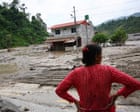
Nepal's foreign minister Shisir Khanal has demanded $20 million in climate compensation for devastating floods that killed or displaced more than 6,000 people, directly challenging wealthy nations to fund recovery from a disaster shaped by global emissions they generated.
Khanal told the Guardian that the world's largest economies must accept responsibility for Nepal's catastrophe. Nepal itself produces less than 0.1% of global greenhouse gas emissions, yet bears the full force of climate-driven disasters in its mountainous terrain.
The floods began when a glacier partially collapsed, triggering a landslide and flash flooding across the nation. Scientists have established that climate change played a direct role in the event. Rising temperatures accelerate glacial melt in the Himalayan region. When glaciers collapse and release enormous volumes of water suddenly, downstream communities face little warning and minimal defense.
Nepal sits in one of Earth's most climate-vulnerable zones. The Himalayas experience warming at roughly twice the global average rate, a phenomenon known as "high-mountain warming." This accelerates snow and ice melt. Intensified monsoon patterns, themselves linked to atmospheric warming, deliver heavier rainfall over shorter periods. When these systems combine, they overwhelm terrain that cannot absorb water at such speeds.
The $20 million figure represents immediate recovery costs. Nepal faces repair of damaged infrastructure, restoration of destroyed homes, and compensation for families who lost livelihoods and relatives. The sum remains modest compared to the economic damage wealthy nations sustain from climate impacts, yet reflects the scale of loss in a country with limited state resources.
Khanal's framing directly invokes the principle of "common but differentiated responsibilities," enshrined in international climate law. This doctrine holds that all nations must reduce emissions, but wealthy countries that industrialized while burning fossil fuels carry greater obligations than developing nations that contributed minimally to atmospheric carbon accumulation.
The demand arrives as Nepal prepares for international climate negotiations. At the UN climate summit in Baku in November 2024, nations debated the New Collective Quantified Goal, a mechanism to channel climate finance from rich to poor countries. Nepal will advocate for compensation mechanisms that treat climate-triggered disasters as loss and damage distinct from adaptation funding.
The United States, European Union, China, and India collectively account for roughly 55% of cumulative historical emissions. These nations possess the fiscal capacity to support countries bearing disproportionate climate impacts. Yet climate finance remains contested. Developed nations have consistently underfunded their pledges. In 2022, wealthy countries delivered only $89.5 billion in climate finance to developing nations, falling short of the promised $100 billion annually.
Nepal's position reflects a broader coalition of vulnerable nations. Small island states, least-developed countries, and mountainous nations have banded together to demand recognition that they face existential climate threats despite near-zero contribution to the problem. Their argument carries scientific weight. Attribution science now demonstrates that specific extreme weather events would have been statistically impossible without human-caused climate change.
The floods underscore how climate impacts distribute unequally across geography. High-altitude regions experience faster warming. Monsoon-dependent agriculture faces intensifying variability. Dense populations in flood-prone valleys amplify human cost when disasters strike. Nepal cannot reduce these vulnerabilities through national action alone. Only emissions cuts by major emitters will slow the pace of Himalayan glacier loss and stabilize precipitation patterns.