# Artist Liz Larner Explores the Living Edge of Sculpture, From Bacterial Culture to Cosmic Inspiration
Sculptor Liz Larner has spent decades pushing materials beyond their conventional boundaries. Her 1988 work "Every Artist Gave a Breath" remains her most visceral experiment. The piece invited artists from around the world to exhale directly onto petri dishes filled with agar, creating what Larner describes as "international art made from breath bacteria." The work was never meant to be stable. Some cultures evolved into delicate, dried wafers with subtle coloration. Others transformed into what Larner calls "really weird blackish-green, really murky and a little scary" formations. The bacteria became the medium itself, responding unpredictably to time and environmental conditions.
This willingness to embrace unstable, living systems distinguishes Larner's practice. The California-based artist works across unconventional materials: hair, eyelashes, leather, and organic matter that most sculptors would discard. Each material carries its own history and decomposition timeline. By incorporating breath and bacterial growth, Larner raises fundamental questions about what constitutes sculpture in an age when art can be biological, temporary, and beyond an artist's full control.
Larner's career reflects a broader shift in contemporary sculpture. While traditional sculpture emphasizes permanence, monumental form, and refined materials like bronze and marble, artists like Larner interrogate impermanence and material authenticity. Her work acknowledges that all matter decays, that life itself is an artistic force, and that collaboration with biological processes yields aesthetic value.
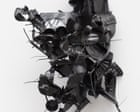
The timing of her continued exploration proves relevant to current cultural anxieties. Larner recently drew inspiration from NASA satellite imagery of asteroids and deep space. This pivot toward cosmic reference points reflects what she observes about contemporary life: we live in what she calls "our dystopian age of space technocrats." The fascination with space imagery, emerging from billionaire-backed space ventures and climate anxiety, has infiltrated visual culture. Where artists once looked to nature or human civilization, they now gaze upward at distant celestial bodies and extraterrestrial possibility.
Larner's shift from bacteria to asteroid imagery represents a tracking of collective consciousness. The petri dish work centered on intimate, invisible life. The asteroid work engages the sublime, the untouchable, the realm that tech billionaires now position as humanity's future refuge. Both approaches, however, maintain Larner's core commitment: using unconventional materials to challenge assumptions about what art can be and how it functions in time.
Her practice also demonstrates art's capacity to engage scientific and medical imagery without didacticism. The petri dishes reference laboratory culture and microbiology, but they resist scientific documentation. They remain stubbornly artistic, resisting clean categorization. Similarly, cosmic imagery functions poetically rather than literally in her work.
Museums and galleries increasingly recognize that sculpture need not be durable or controllable. Larner's influence appears across contemporary practice, from artists working with natural decay to those incorporating living systems. Her work validates the idea that collaboration with entropy and biological process generates forms of beauty and meaning that static, finished objects cannot achieve.