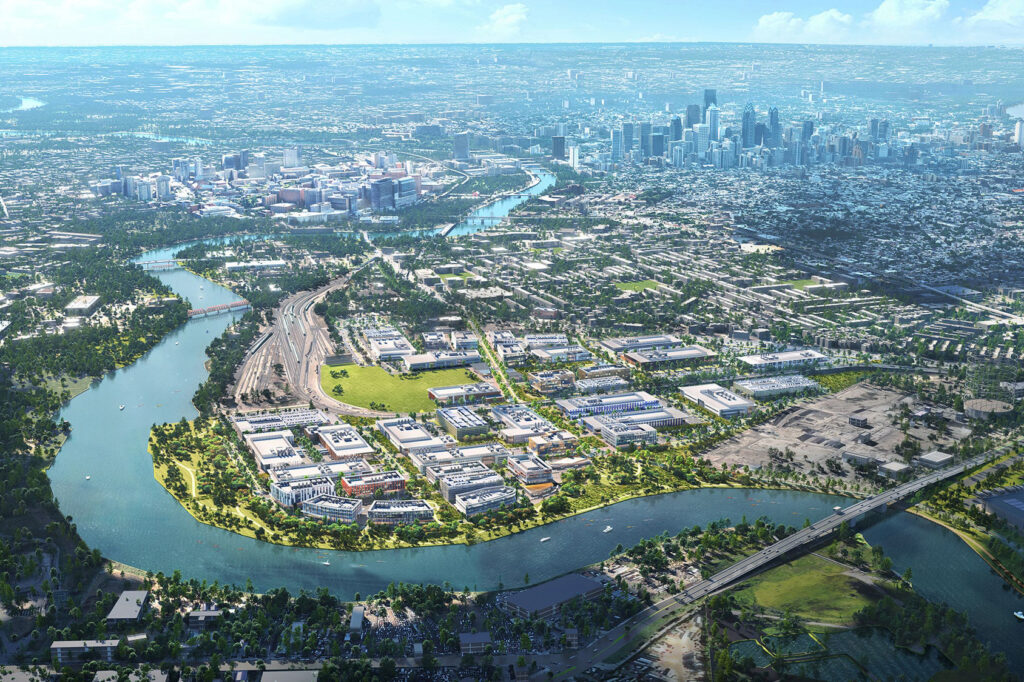
# Data Center Proposal Threatens Philadelphia's Industrial Bellwether District
Philadelphia's Planning Commission has identified the Bellwether District, a longstanding industrial zone, as one of only two sites in the city suitable for a large-scale data center. The designation has revived questions about land use priorities in a neighborhood built on manufacturing and warehouse operations.
The commission made the determination in a presentation last month without confirming any active development proposals. Neither the Planning Commission nor HRP Group, the current site owner, reports pending data center plans. Yet the identification alone has triggered debate over whether the district should preserve its industrial character or adapt to the demands of digital infrastructure.
Data centers consume massive amounts of electricity and water. A single large facility can demand 30-100 megawatts of power continuously, equivalent to the draw of 25,000 to 80,000 homes. This load has environmental implications that reach beyond the Bellwether District itself.
Philadelphia's electrical grid draws power from multiple sources. In 2023, Pennsylvania generated approximately 40 percent of its electricity from natural gas, 35 percent from nuclear plants, and 8 percent from wind and solar combined. A major data center would likely increase regional demand for power, potentially extending reliance on fossil fuels unless the city expedites renewable energy procurement.
Water consumption presents a parallel concern. Data centers use water for cooling systems. Depending on design and climate, a large facility can consume 2 to 3 gallons per megawatt-hour of processing. Philadelphia relies on surface water from the Schuylkill River and Delaware River. Climate projections show the Mid-Atlantic region facing increased drought stress by 2050, which could strain both municipal supply and the cooling capacity data centers require.
The Bellwether District occupies roughly 1,200 acres in Southwest Philadelphia. Its zoning history reflects post-industrial urbanism: manufacturing operations shifted overseas decades ago, giving way to warehouses, logistics hubs, and distribution centers. Property values remained relatively low, making the zone attractive to industrial tenants priced out of gentrifying neighborhoods.
A data center would reverse this pattern. Tech infrastructure anchors attract investment capital, workforce development funding, and often premium property values. Existing manufacturers and warehouse operators could face displacement pressure or lease rate escalation as the district's perceived value climbs.
The Planning Commission did not announce a formal zoning change or development timeline. Its identification of the Bellwether site as data-center-capable functions as strategic documentation for future proposals. Developers pursuing data center permits will likely cite the commission's finding to streamline approval processes.
Philadelphia has no explicit data center policy. Unlike cities such as Dublin, Singapore, and Seoul, which regulate data center density and energy sourcing through municipal ordinance, Philadelphia leaves decisions to case-by-case review. A data center arriving in the Bellwether District would operate under existing commercial and industrial codes without performance standards for emissions or water use.
The city's climate action plan, adopted in 2019, commits Philadelphia to 100 percent clean electricity by 2050. Meeting that target requires grid decarbonization accelerating faster than current policies support. Adding major loads from data centers without concurrent renewable energy development would complicate the transition.
HRP Group has not disclosed plans for the site. Public comment periods and zoning hearings would follow any formal proposal. Residents and industrial tenants retain opportunity to engage the decision, though the Planning Commission's designation has effectively opened the door.