# El Niño's Intensifying Feedback Loop Accelerates Global Warming
Judith Cole and her team at the University of Michigan have identified a dangerous feedback mechanism linking El Niño and global heating. Research published this week in Science demonstrates that warming oceans generate stronger El Niño events, which in turn amplify global temperature increases.
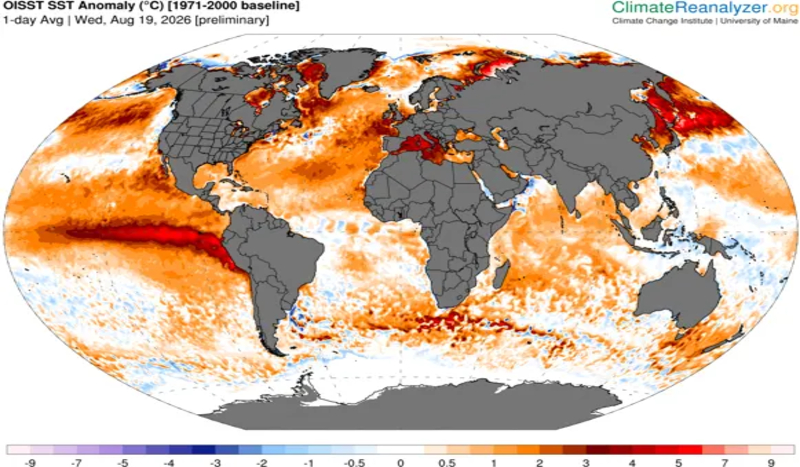
The cycle operates as follows. El Niño, the periodic warming of equatorial Pacific waters, naturally releases stored heat into the atmosphere. When baseline ocean temperatures rise due to anthropogenic climate change, these cyclical events start from a warmer baseline. This means each El Niño episode now delivers more atmospheric heating than the same phenomenon would have decades ago.
That added heating then drives further ocean warming. Warmer oceans create conditions favoring more intense El Niño episodes in subsequent years. Each iteration of the cycle strengthens the next one.
Cole explained the mechanism to The Guardian: "We are seeing a trend of stronger El Niños." The research quantifies this trend and establishes the physical causation driving it.
This feedback loop carries immediate consequences. El Niño episodes already disrupt global weather patterns, triggering droughts in some regions, flooding in others, and widespread agricultural stress. Stronger events compound these impacts. The 2023-2024 El Niño contributed to record global temperatures that year. Scientists expect intensified future events to push climate records higher still.
The University of Michigan research adds to mounting evidence that Earth's climate system contains multiple reinforcing feedback loops that accelerate warming beyond what linear models predict. As carbon dioxide accumulates in the atmosphere, the climate doesn't warm at a steady rate. Instead, various mechanisms amplify the warming trajectory.
El Niño intensity matters at planetary scale. The phenomenon affects precipitation, temperature, and storm patterns across most of the globe. Stronger events mean larger temperature anomalies in the tropics, which propagate globally. Fisheries dependent on Pacific upwelling collapse during strong El Niño years, threatening food security for millions.
The research arrives as atmospheric CO2 concentrations approached 420 parts per million in 2024, higher than any point in human history. Ocean temperatures set records for consecutive months. These trends create conditions for more powerful El Niño cycling.
Climate models must now incorporate this feedback mechanism to generate accurate projections. Earlier models that didn't account for intensifying El Niño cycles may have underestimated warming trajectories through 2100. Cole's work suggests the atmosphere faces faster heating acceleration than previously calculated.
The findings reinforce the urgency of emissions reductions. Each tenth of a degree of additional warming increases El Niño intensity, which generates additional warming, which produces stronger future events. Stabilizing climate requires breaking this cycle by reducing atmospheric CO2 concentrations. Without aggressive mitigation, the feedback loop continues tightening indefinitely.