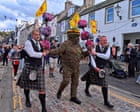
The Burryman procession, an August tradition in South Queensferry near Edinburgh, involves a volunteer covered entirely in thousands of hooked burdock seedheads who walks a seven-mile route for up to 10 hours. The custom, part of the Ferry Fair, dates back centuries and represents one of Scotland's most distinctive local rituals.
The Burryman stops at approximately 20 locations throughout the town to collect charitable donations while accompanied by two attendants. Participants accept whisky at each stop, a practice embedded in the festival's social fabric. The burdock seedheads attach like Velcro, creating a dense covering that requires significant preparation and endurance.
This tradition carries cultural weight beyond tourism. It represents community participation rooted in folk custom rather than commercial spectacle. Unlike the Edinburgh Festival's international profile 10 miles away, the Burryman procession remains distinctly local, drawing residents and maintaining continuity with historical practice.
The article references an impending change of leadership within the tradition, suggesting transitions in who assumes the ceremonial role. Such shifts matter for folk customs, as they determine whether practices survive generationally or fade with older participants. The voluntary nature of the role means succession depends on community commitment rather than institutional infrastructure.
The use of burdock seedheads connects the ritual to the natural landscape of West Lothian. This organic material defines the custom's visual character and ties participants directly to local ecology rather than imported props or costumes.
The procession embodies how marginalized traditions persist in overlooked spaces. While Edinburgh's festival dominates media attention and visitor flows, South Queensferry maintains an autonomous cultural practice that serves local functions. Charitable giving, community gathering, and costume tradition converge in a single day that residents and locals regard as a meaningful event regardless of external recognition.
The Burryman procession demonstrates how communities