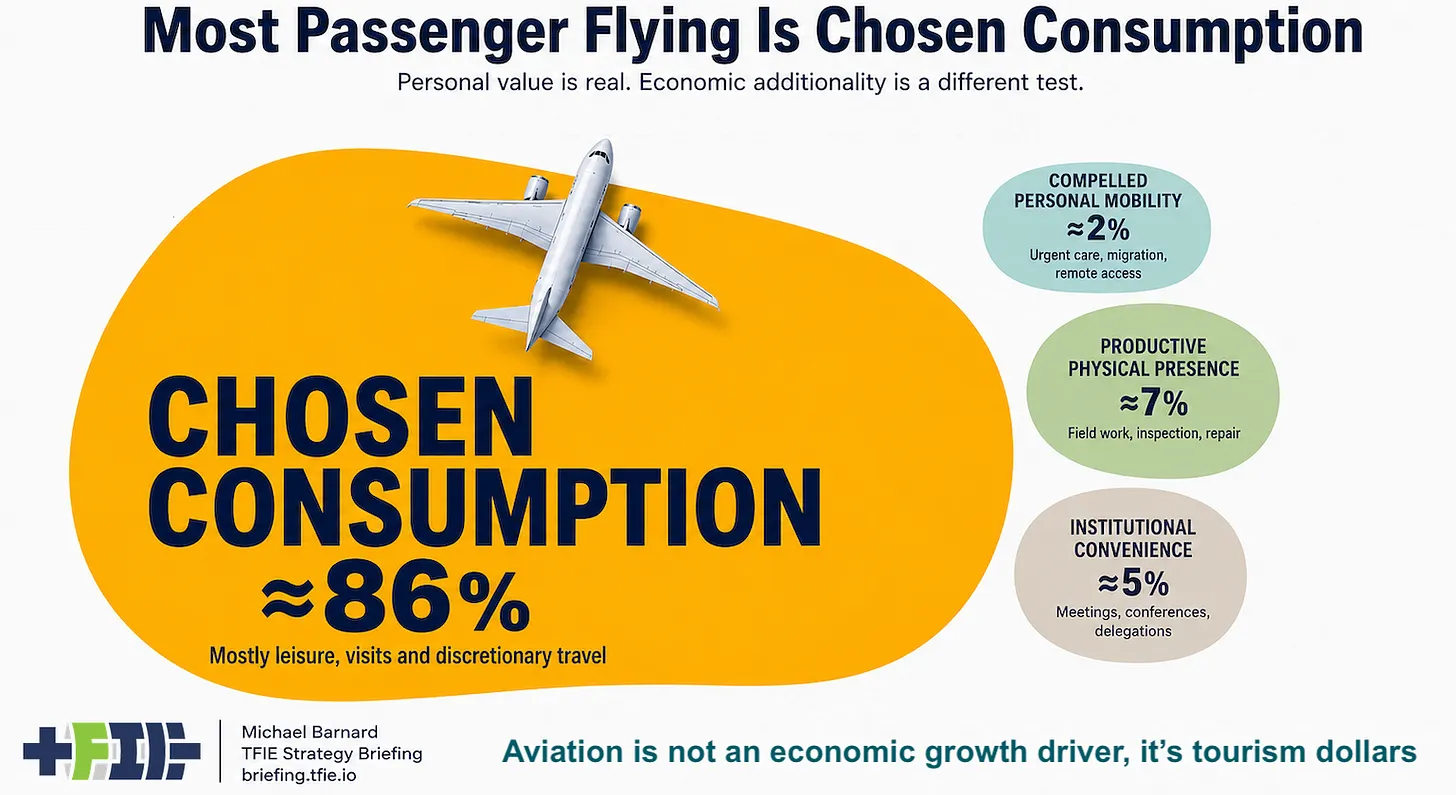
The aviation industry contributes roughly $4 trillion to global economic activity, but this figure masks a critical problem: not every flight generates genuine economic growth. The sector's massive footprint conflates total activity with additionality, the economic principle that distinguishes new value creation from mere displacement of existing activity.
Aviation does perform legitimate economic functions. It connects isolated communities, transports time-sensitive and high-value cargo, supports tourism-dependent regions, and enables some work requiring physical presence at sites, with equipment, or for negotiations with partners. These services justify aviation as an industry.
The issue emerges when policymakers and industry advocates treat the sector's $4 trillion economic contribution as evidence that expansion always creates growth. Many flights substitute for existing transportation rather than generating new economic activity. A business traveler flying between two cities might substitute air travel for a video conference, shifting spending rather than creating it. A holiday flight competes with domestic vacations for consumer dollars. Leisure travel diverts spending from local entertainment.
This distinction matters for climate policy. Aviation accounts for approximately 2-3 percent of global carbon emissions, with projections showing rapid growth as passenger numbers increase. The International Civil Aviation Organization forecasts air travel could double by 2050 under current trajectories. If every new flight truly added economic value, the climate trade-off would involve genuine opportunity costs. But if many flights cannibalize spending from lower-emission activities, the climate case for restraint strengthens.
The carbon intensity of aviation remains high despite efficiency improvements. Airlines have reduced fuel consumption per seat kilometer, yet absolute emissions continue rising because traffic growth outpaces efficiency gains. Sustainable aviation fuels and electrification offer partial solutions for narrow-body routes, but long-haul flights face decades of high-carbon dependency.
The economic argument for aviation expansion therefore requires scrutiny beyond aggregate footprint numbers. Distinguishing flights that create new economic opportunities