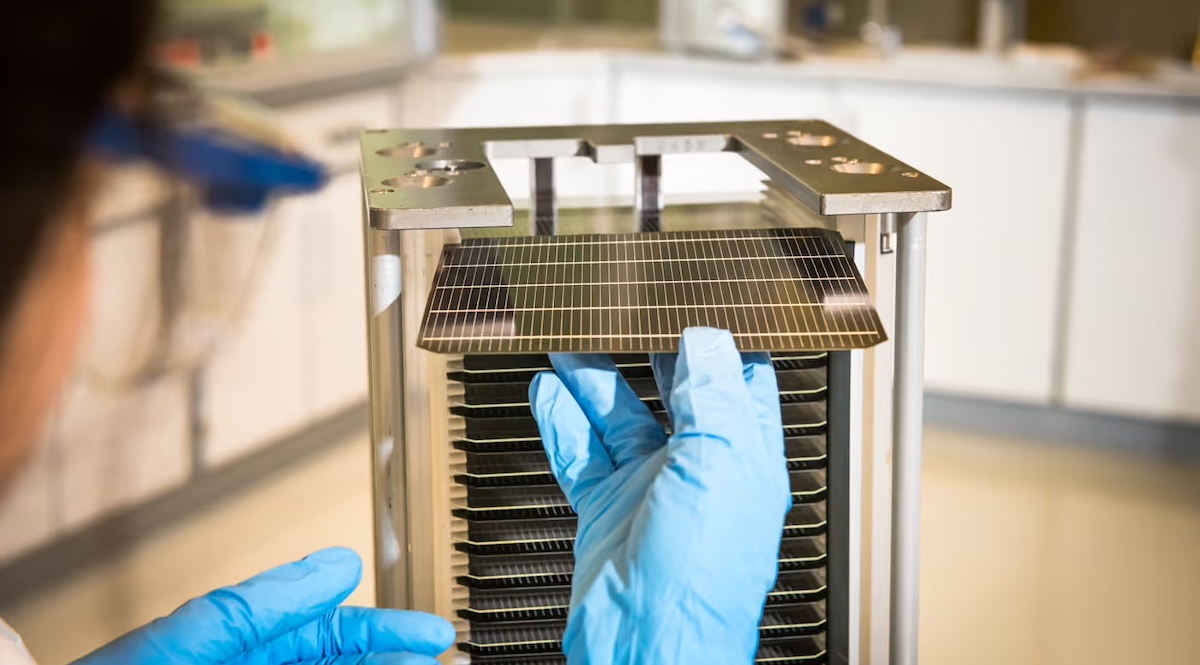
Oxford PV and Fraunhofer Institute for Solar Energy Systems ISE have integrated perovskite-silicon tandem solar cells with Matrix Shingle interconnection technology in a single photovoltaic module. The collaboration pairs Oxford PV's high-efficiency perovskite-silicon cells with Fraunhofer ISE's proprietary Matrix Shingle connection method to boost overall panel performance.
Perovskite-silicon tandem cells work by stacking a perovskite layer atop traditional silicon cells. This dual-layer structure captures a broader spectrum of sunlight than silicon alone, potentially reaching conversion efficiencies above 30 percent. Oxford PV has emerged as the leading commercializer of this technology, which remains in early deployment stages.
Matrix Shingle interconnection represents an advancement in how solar cells connect within a module. Rather than traditional busbars that cross entire cells, the shingle design uses overlapping cell strips with narrow conductive connections. This geometry reduces resistive losses, minimizes shading, and enables more compact module designs. Fraunhofer ISE developed the technology to improve electrical efficiency and thermal management.
Combining these technologies addresses a critical challenge in solar manufacturing. Perovskite-silicon cells demand precise handling and protection, while interconnection methods must maintain electrical integrity without degrading the delicate perovskite layer. The collaboration demonstrates that Matrix Shingle architecture can accommodate tandem cell requirements while preserving efficiency gains.
The project signals growing convergence in solar technology development. Perovskite-silicon tandems offer a path to efficiency improvements without requiring wholesale manufacturing infrastructure changes, since they build on existing silicon cell production lines. Interconnection innovations like Matrix Shingle unlock additional performance by reducing electrical losses across the module.
Neither organization disclosed specific efficiency ratings for modules combining both technologies or timelines for commercial production. Fraunhofer