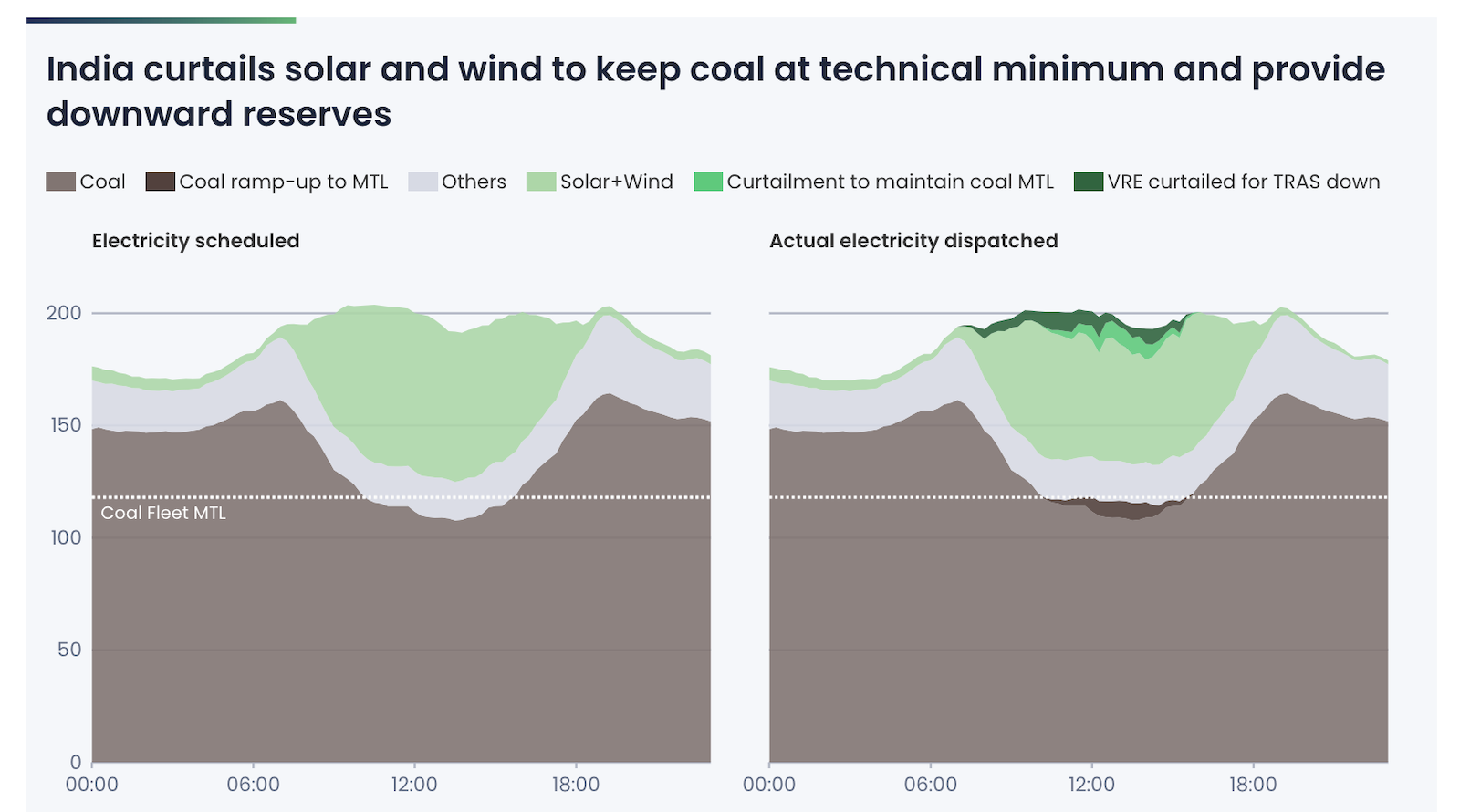
India requires an immediate deployment of 10 gigawatt-hours of battery storage to prevent renewable energy waste caused by coal plants' operational constraints. The nation's coal fleet cannot ramp down quickly enough during peak solar generation hours, forcing utilities to curtail clean power rather than reduce coal output.
India's solar capacity surges during midday hours, creating a fundamental mismatch with inflexible coal infrastructure. Coal plants operate most efficiently at constant, high output levels. Rapidly scaling down production damages equipment and increases operational costs, making utilities reluctant to reduce coal generation when solar floods the grid. This technical inflexibility forces operators to reject clean energy instead.
Battery storage solves this dispatch problem directly. Batteries absorb excess solar generation during peak hours and release it during periods of lower renewable output, smoothing grid operations without requiring coal plants to cycle. A 10 GWh battery capacity would provide enough storage to capture midday solar surplus and redistribute that power across the daily demand curve.
The urgency reflects India's energy transition reality. The country has committed to 500 gigawatts of renewable capacity by 2030, with solar representing the bulk of that growth. Coal still provides roughly 70 percent of India's electricity, and plant retirement timelines remain slow. This gap between expanding renewables and persistent coal dependence creates the storage bottleneck.
India currently operates battery storage at minimal scale, leaving vast renewable curtailment occurring annually. As solar deployment accelerates, this wasted clean energy grows costlier economically and environmentally. Every megawatt-hour of solar curtailed represents missed decarbonization progress and economic inefficiency.
Battery technology costs have fallen 89 percent since 2010, making large-scale deployment economically viable. India's Ministry of Power and renewable energy agencies acknowledge battery storage as essential infrastructure for grid stability. Achieving the 10 GWh target