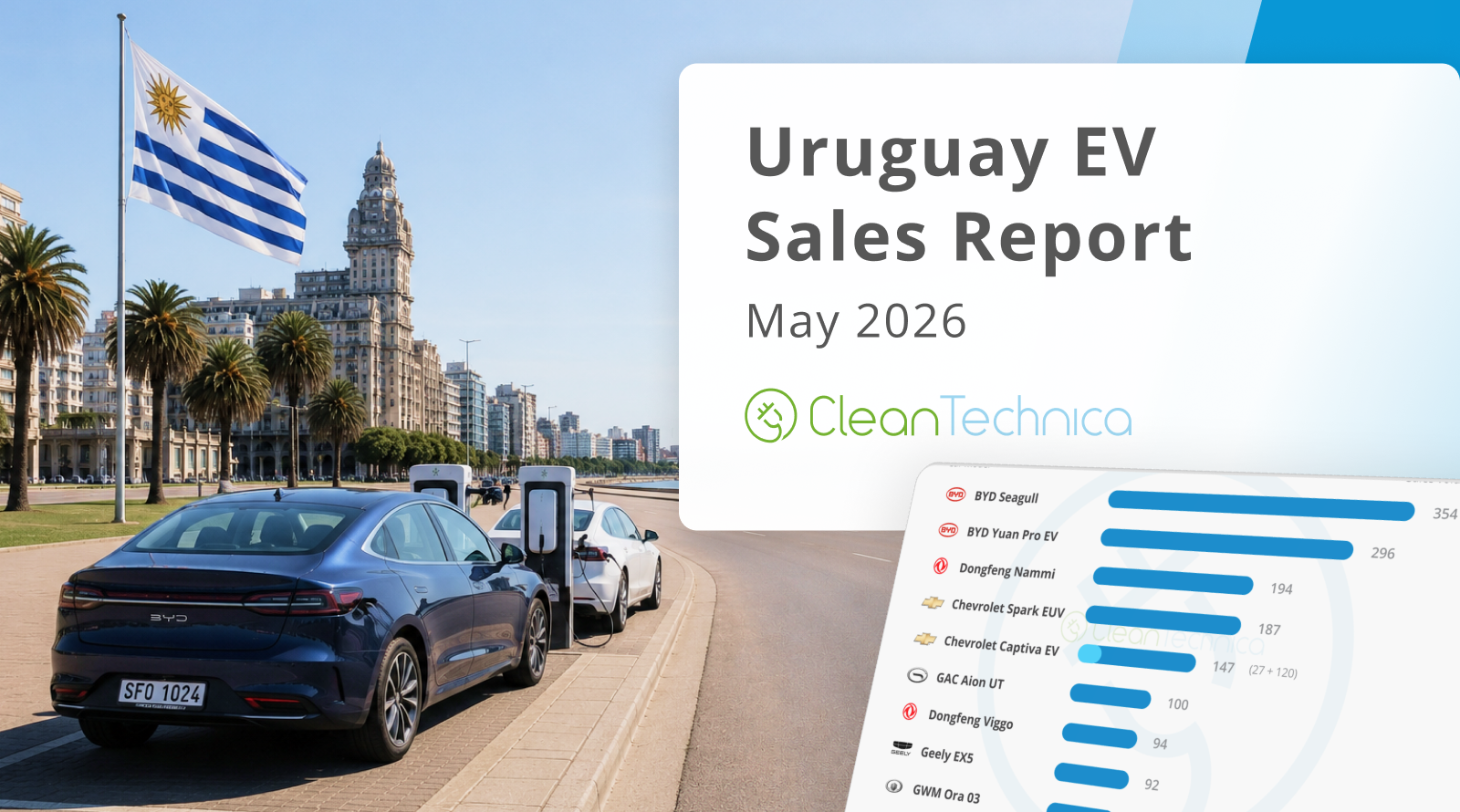
Uruguay has become Latin America's electric vehicle leader, with battery electric vehicles capturing 40% of new car sales in May 2026. The country reached 20% BEV market share for all of 2025, nearly tripling from 8.5% in 2024. It now surpasses Costa Rica as the region's top performer in EV adoption.
The rapid shift reflects structural changes in Uruguay's automotive market. Internal combustion engine vehicle sales are declining as consumer demand pivots toward battery electric options. May's 40% BEV share demonstrates acceleration beyond the year-to-date pace, signaling sustained momentum rather than a temporary spike.
Uruguay's position stems from multiple factors. The country has implemented supportive EV policies including tax incentives on battery vehicles and charging infrastructure investments. Supply-side factors also matter. Importers have expanded their EV portfolios in response to growing demand, while global EV production capacity has increased, making vehicles more accessible.
The shift carries implications for Uruguay's climate targets and energy system. Transportation accounts for roughly a quarter of Latin American carbon emissions. Displacing gasoline vehicles with electric alternatives reduces direct tailpipe emissions, particularly when paired with grid decarbonization. Uruguay's electricity generation already relies heavily on renewable sources, including wind and hydropower, making EV adoption more impactful for emissions reduction than in regions dependent on fossil fuel power.
This trajectory contrasts sharply with global patterns. Most countries still see BEVs below 15% market share. Uruguay's 40% monthly penetration rate places it among the world's fastest-adopting markets, comparable to Norway and parts of Western Europe.
The data raises questions about regional equity. While Uruguay demonstrates rapid EV scaling is achievable in Latin America, other countries face barriers including lower incomes, limited charging networks, and weaker policy support. Replicating Uruguay's model