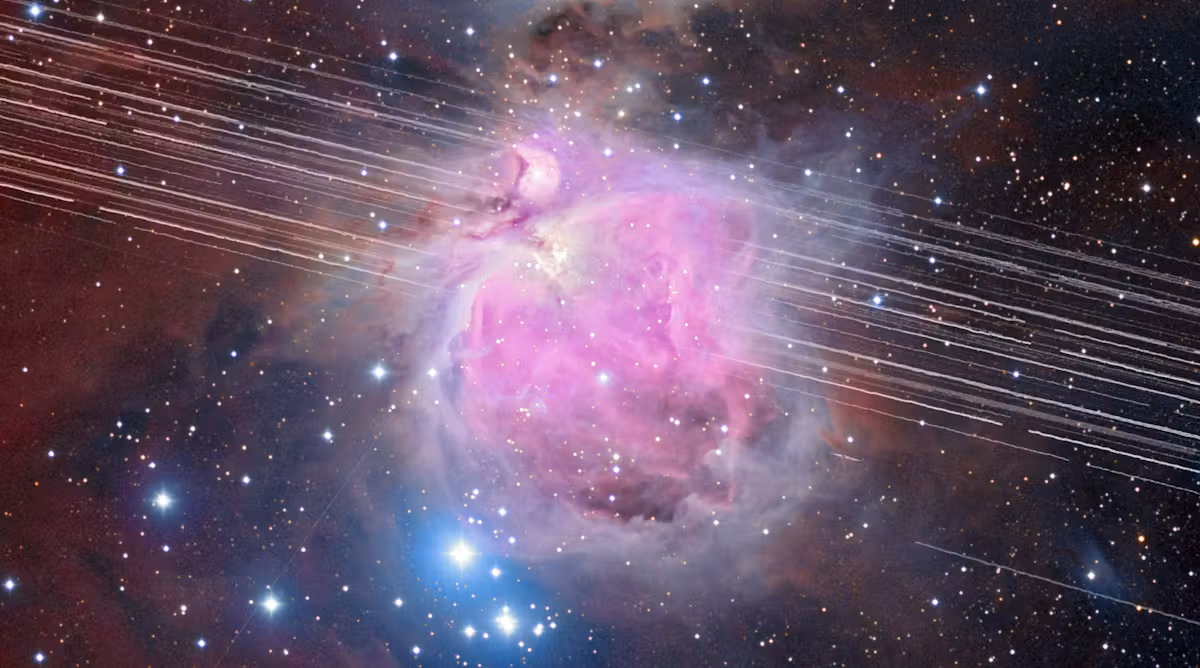
The United States Federal Communications Commission approved SpaceX's plan to launch one million "Starmind" artificial intelligence data centre satellites this week. The satellites would multiply the number of operational satellites by a factor of 50, according to the report.
SpaceX proposes to use solar-powered satellites to perform AI data processing in space and transmit results to Earth. Launching one million satellites would require roughly 500 satellites to launch every day if each has a five-year lifespan. At end-of-life, roughly 500 satellites per day would need to be disposed of through atmospheric reentry.
Satellite reentry deposits materials into the upper atmosphere at rates now exceeding natural meteor contributions. Aluminium deposits pose particular concern because alumina can destroy ozone in the upper atmosphere, potentially increasing ultraviolet light exposure and skin cancer risk.
Each Starmind satellite would be 75 metres wide. During early evening, hundreds of these satellites would be visible above the horizon from any location on Earth, brighter than stars. Satellites travel at roughly seven kilometres per second, and collisions produce debris clouds that can trigger further collisions, risking what astronomers call Kessler Syndrome, a cascade of debris that could render low Earth orbit unusable.
The Federal Communications Commission declined to require environmental review under the National Environmental Policy Act for the Starmind system. The commission's decision reflects a looser approach to satellite regulation under the Trump administration, the report states.
Data centre cooling presents engineering challenges in space. Google's recent AI demonstrator satellite required downtime between calculations to manage excess heat. The report notes that deploying AI in orbit costs vastly more than equivalent Earth-based AI, and current AI investment levels far exceed revenues.