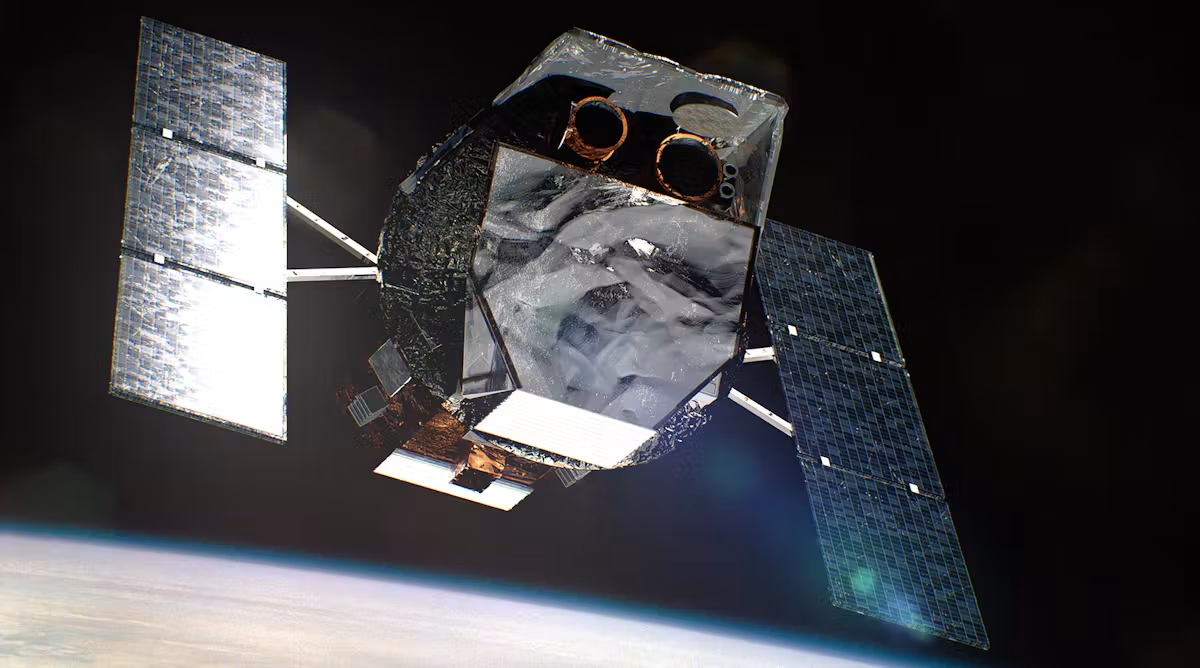
NASA's Neil Gehrels Swift Observatory reentered Earth's atmosphere on Nov. 4, 2026, above North Sumatra, Indonesia, ending a 20-year mission observing cosmic explosions. The telescope had sunk to 171 miles above Earth, where atmospheric drag prevented its instruments from holding steady. NASA ended the mission three days after Swift's final observation on Oct. 20.
The reentry followed a failed rescue attempt by LINK, a commercial robotic spacecraft. NASA contracted Katalyst Space for $30 million in September 2025 to design, build, test and launch LINK within less than a year. LINK launched on July 3, 2026, with a plan to approach Swift, grab it with one of three robotic arms, and boost it to 373 miles altitude where it could continue operating.
In late July, LINK lost two of its three reaction wheels, which help spacecraft turn without using fuel. Combined with propulsion system problems, this sent LINK into an uncontrolled spin. Engineers fired its thrusters to slow the rotation from nine degrees per second to about one and a half degrees per second by August.
Despite slowing LINK's spin, engineers determined the spacecraft no longer had enough propellant to capture Swift and raise its orbit safely. NASA and Katalyst called off the capture in late August. LINK flew within 7.5 to 9 miles of Swift, deployed its robotic arms and tested its thrusters, but never approached closely enough to grab the telescope. LINK reentered the atmosphere in September.
A servicing spacecraft must distribute its finite propellant supply among multiple tasks: reaching the target, approaching safely, capturing it and moving it to a new orbit, with reserves for unexpected problems. Extra propellant increases launch costs and fuel requirements. Starting in 2024, increased solar activity swelled Earth's upper atmosphere, pulling Swift down faster than expected, compressing the timeline for rescue.
NASA said LINK's effort provided experience in quickly building, launching and operating a servicing spacecraft. Engineers demonstrated they could upload new control software to stabilize a damaged spacecraft with remaining hardware and tested the robotic arms and thrusters in orbit.
Future satellite rescue missions are developing two approaches. Astroscale's ELSA-M targets satellites equipped with docking plates installed before launch. The European Space Agency's ClearSpace-1, planned for 2029, aims to capture and remove the Proba-1 satellite, which has no docking plate.