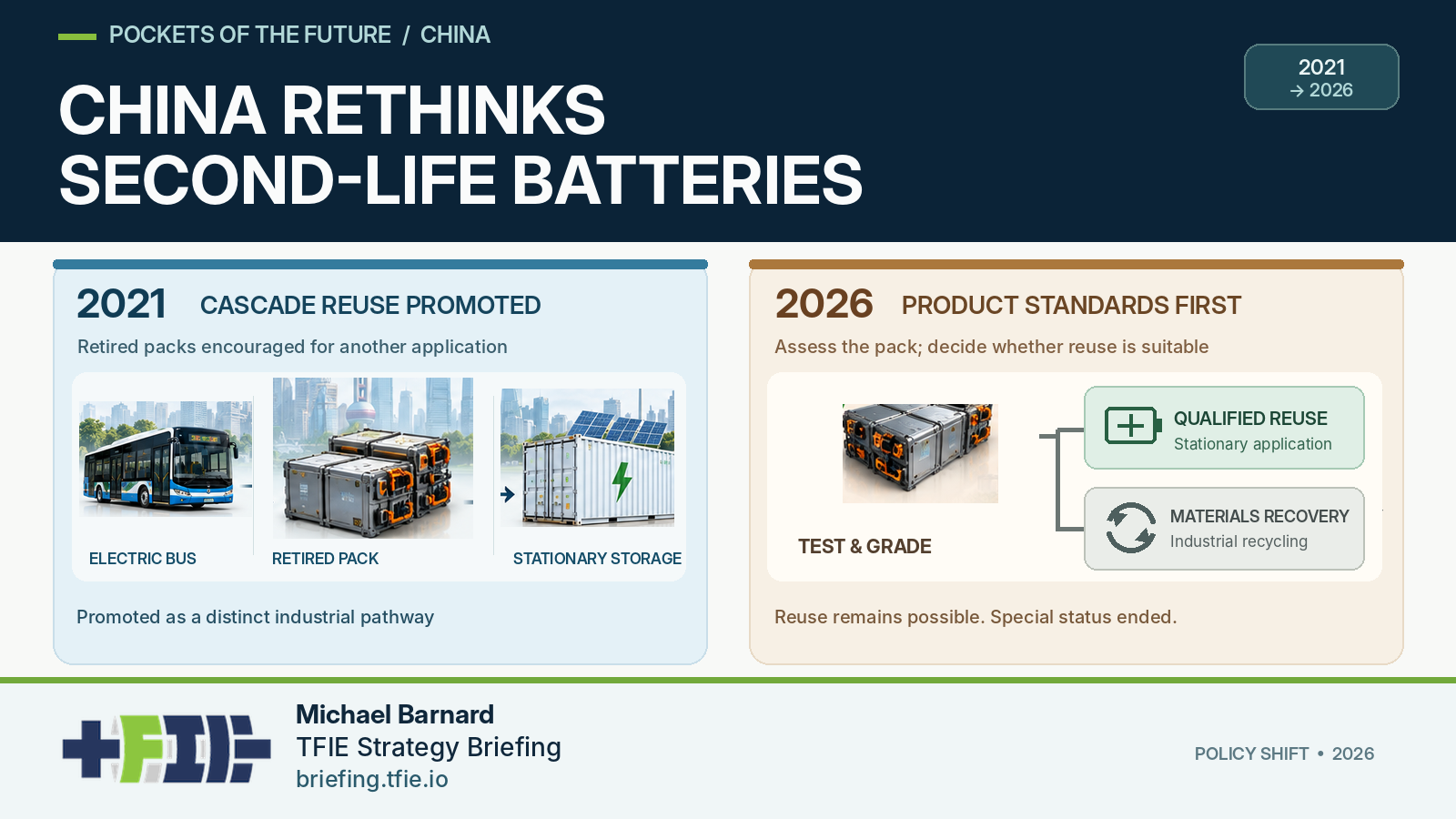
China's decision to step back from promoting second-life EV batteries should prompt a reality check across the global electric vehicle industry. The country that electrified its urban bus fleets with impressive speed—achieving 551,400 new-energy urban buses representing 87.5% of the fleet by the end of 2025—has discovered that the path from automotive use to stationary storage is far more complicated than the 2021 cascade-utilization framework assumed. The April 2026 rule changes and the July 30 Ministry of Industry and Information Technology announcement withdrawing special recognition for cascade-utilization companies signal not a failure of the circular economy concept, but a necessary correction based on real-world challenges.
The shift deserves clarity: this is not a ban on second-life batteries, as some reports have suggested. Retired vehicle batteries can still be used in suitable applications meeting applicable standards. However, the ministry's stated concern about the safety of inadequately tested, reassembled batteries with varying remaining capacity and inconsistent cell condition points to a genuine problem. When batteries with different ages, designs, and operating histories are repackaged with inconsistent controls and warranties, safety cannot be guaranteed. This is not regulatory overreach—it is responsible governance.
What China's experience reveals is that the economics of battery reuse are far less favorable than early enthusiasm suggested. New lithium iron phosphate batteries have become dramatically cheaper, while the costs of testing, repackaging, controls, and warranties for retired packs consume the savings that reuse was supposed to deliver. A second-life installation must compete with new products specifically designed for stationary applications, a competition it often loses. The assumptions that made sense when batteries were expensive and early electric fleets were young are crumbling as industrial scale meets practical reality.
This does not mean second-life batteries have no role. Operators with known battery histories and suitable stationary applications may find genuine economic and environmental advantage. But the broader promise of a circular battery economy powered primarily by cascade utilization appears oversold. Rather than assuming retired EV batteries will automatically fill energy storage needs, stakeholders should focus on where reuse actually works: specific applications with manageable risk profiles and demonstrable economic viability.
The lesson for other nations approaching this transition is urgent. European policymakers and investors must reconsider assumptions about the supply of retired batteries and the viability of second-life markets. China's regulatory course correction, born from experience managing 551,400 buses worth of battery retirement, offers a costly education in what genuinely sustainable EV circularity requires: ruthless honesty about economics, unwavering commitment to safety standards, and abandonment of wishful thinking about reuse.