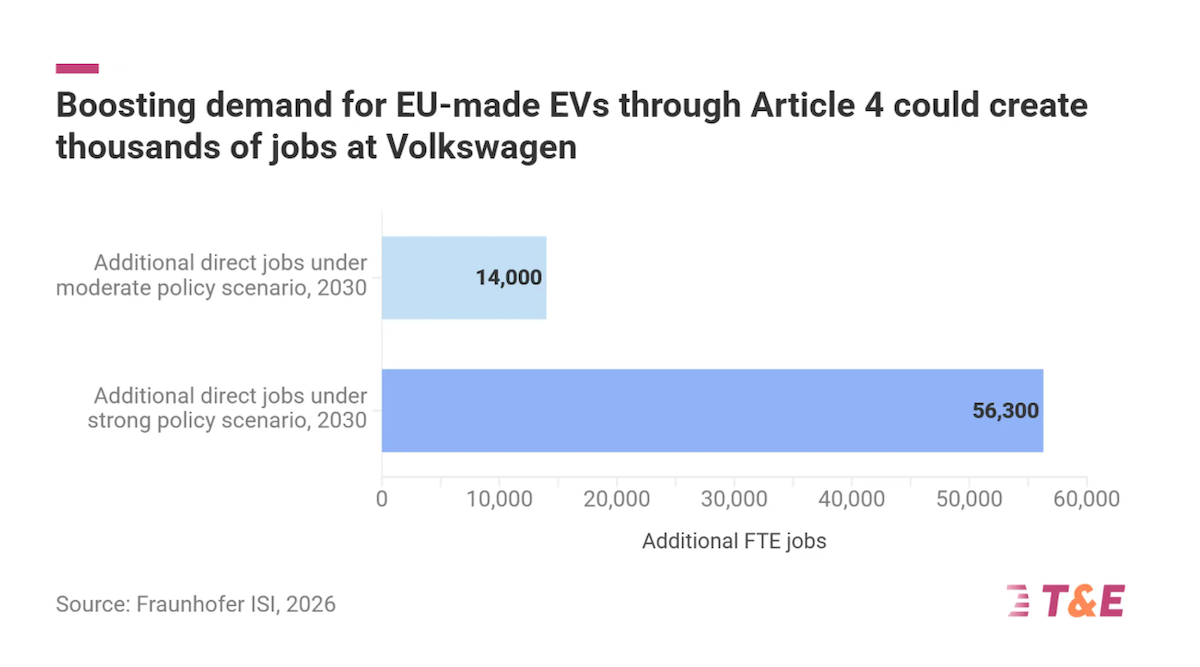
The European Union's Clean Corporate Vehicles Regulation stands to generate substantial economic benefits for Europe's industrial sector, according to independent modeling by Fraunhofer ISI. The analysis projects that implementing the CCVR could create up to €48 billion in value and generate 344,000 jobs by 2030.
The regulation establishes binding minimum targets requiring large companies to purchase zero- and low-emission vehicles, or ZLEVs, as part of their new car registrations. This framework targets corporate fleets, which represent a significant share of vehicle purchases across the EU.
The economic modeling highlights the regulation's potential to stimulate domestic industrial activity. By mandating corporate procurement of ZLEVs, the policy creates sustained demand for electric and low-emission vehicles produced within the EU manufacturing base. This demand mechanism translates into job creation across manufacturing, supply chain, and related services sectors.
The €48 billion figure represents cumulative value creation across the period leading to 2030, reflecting both direct manufacturing output and indirect economic activity generated through the supply chain. The 344,000 jobs projection spans the same timeframe, indicating employment growth across multiple sectors tied to increased ZLEVB production and deployment.
The regulation operates through binding targets rather than voluntary commitments, establishing certainty for manufacturers and suppliers planning investment in electric vehicle production capacity. Large companies subject to the regulation face clear requirements to shift their procurement toward zero- and low-emission options, providing market predictability.
Fraunhofer ISI, a leading research institute, conducted the independent analysis, lending technical credibility to the projections. The modeling incorporates assumptions about compliance pathways, manufacturing scale-up, and related economic effects throughout the value chain.
The regulation represents a significant policy tool for accelerating Europe's transition toward low-emission transportation while simultaneously supporting domestic industrial competitiveness and employment in the sector.
CATEGORY