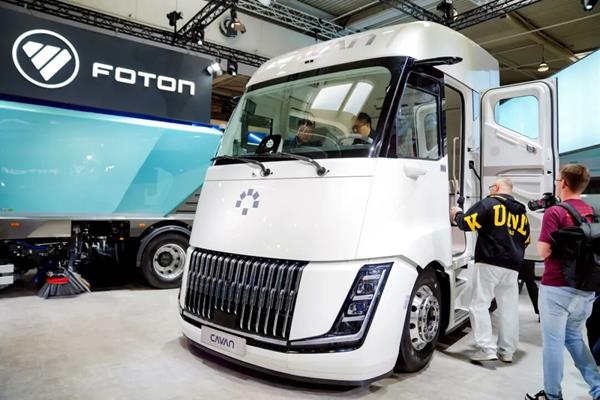
Chinese commercial vehicle manufacturer BAIC-Foton announced an aggressive European expansion strategy at the IAA Transportation 2026 trade show in Hannover, Germany, unveiling the "Cavan Beacon" freight truck as the centerpiece of its product offensive in the region.
The company used the sprawling exhibition to signal that its European ambitions extend beyond simply exporting vehicles from China. At a dedicated press briefing in Hall 21, BAIC-Foton executives outlined an expansive product strategy that positions the manufacturer as a serious competitor in Europe's commercial vehicle market, a sector historically dominated by established players like Volvo, Scania, Mercedes-Benz, and MAN.
The Cavan Beacon represents BAIC-Foton's push into the heavy-duty freight segment, a market segment facing mounting pressure to electrify and decarbonize. European Union regulations require heavy-duty vehicle manufacturers to reduce CO2 emissions from new trucks by 15 percent between 2025 and 2029, and by 30 percent between 2030 and 2034. These mandates have forced traditional manufacturers and new entrants alike to invest heavily in battery-electric and hydrogen fuel cell technologies.
BAIC-Foton, owned by Beijing Automotive Group, has emerged as one of China's largest commercial vehicle makers. The company produces light-duty vans, medium-duty trucks, and heavy-duty tractors. Its entry into the European market reflects China's broader strategy to establish manufacturing and distribution networks in developed economies, mirroring earlier successes in passenger electric vehicles.
The timing of the Hannover announcement aligns with accelerating European truck electrification. Battery-electric trucks from Volvo Trucks, Scania, Daimler Truck subsidiary Mercedes, and MAN have begun operating in limited numbers across Europe. Startup manufacturers like Volta Trucks and Fuso eCanter have also entered the market. However, limited charging infrastructure and high upfront costs remain barriers to mass adoption.
BAIC-Foton's participation in IAA Transportation 2026 signals confidence in European market conditions and suggests the company plans localized operations rather than simple export arrangements. Chinese commercial vehicle manufacturers have pursued European market access steadily since the mid-2010s, though most have struggled against entrenched competitors and regional preferences for established brands.
The company's product offensive includes not just the Cavan Beacon but a broader lineup designed to address different segments of the European commercial vehicle market. Details about powertrain options, pricing, and European distribution partnerships remain limited based on available information, though industry observers expect clarification in coming months as BAIC-Foton details its European strategy further.
For European truck buyers and fleet operators, BAIC-Foton's arrival introduces new competitive dynamics at a critical moment. The commercial vehicle sector faces unprecedented pressure to transition away from diesel engines within the next 10-15 years. Manufacturers offering affordable, reliable alternatives to established Western brands could capture significant market share from operators seeking to manage transition costs.
The regulatory environment supporting this transition extends beyond emissions standards. The EU's Carbon Border Adjustment Mechanism and proposed rules requiring zero-emission heavy-duty vehicles in certain applications create additional compliance obligations for manufacturers and fleet operators. These factors make this an opportune moment for new entrants to establish European footholds.