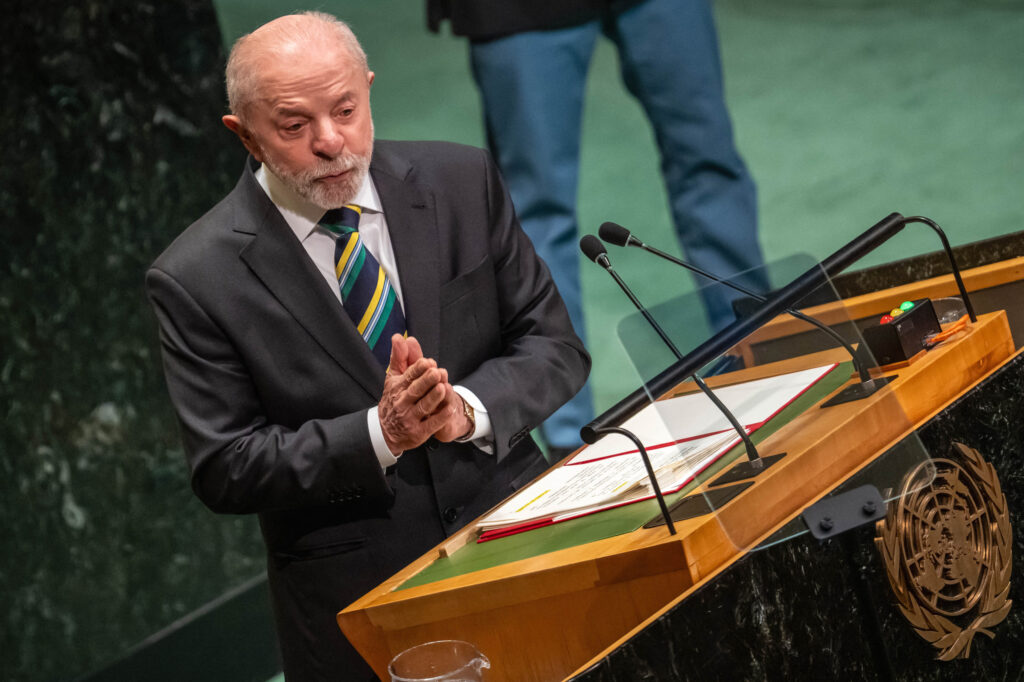
# Competing Climate Visions Clash at UN General Assembly
Brazil's President Luiz Inácio Lula da Silva and U.S. President Donald Trump presented sharply opposing climate strategies at the opening of the UN General Assembly's 81st session in New York, crystallizing the policy fracture that will define international climate negotiations ahead.
Lula called for rapid decarbonization of national economies, aggressive forest protection, and accelerated energy transitions supported by technology transfer from wealthy nations to developing countries. His address prioritized the dual crisis of climate change and biodiversity loss, positioning Brazil as a leader on both fronts. The statement aligns with Brazil's commitments under the Paris Agreement and reflects mounting pressure to control Amazon deforestation, which has accelerated in recent years.
Trump rejected climate action frameworks, a departure that signals potential U.S. withdrawal from collaborative climate diplomacy. His position echoes his first term, when the United States exited the Paris Agreement before rejoining under President Joe Biden in 2021.
The clash matters because the world's two largest economies in the Americas cannot drive the energy transition without coordinated policy. Brazil leads global renewable energy adoption, with hydropower and ethanol fuels comprising over 50 percent of its energy mix. The U.S. remains the world's second-largest greenhouse gas emitter by total volume, though China leads in annual emissions. Together, these nations account for roughly 30 percent of global GDP.
Lula's emphasis on technology transfer reflects a core grievance in climate negotiations. Developing nations argue that industrialized countries grew wealthy by burning fossil fuels without restriction, then imposed climate limits on poorer nations. Tech transfer mechanisms promised under the Paris Agreement have fallen short of commitments. The UN Climate Change High-Level Champions office reports that developed nations pledged $100 billion annually to climate finance by 2020; as of 2022, they delivered approximately $89 billion.
The divergence carries concrete consequences for the 29th UN Climate Change Conference (COP29), scheduled for Baku, Azerbaijan in November 2024. Negotiations will determine how much money wealthy nations contribute to climate adaptation in vulnerable countries, how quickly coal phase-outs occur, and whether carbon markets expand. A fractious U.S. position weakens the bargaining power of climate-ambitious nations.
Trump's rejection of climate frameworks contradicts market realities. U.S. renewable energy installations grew 50 percent between 2020 and 2023, driven partly by the 2022 Inflation Reduction Act, which allocated $369 billion for clean energy. Major corporations from Apple to Microsoft have committed to net-zero emissions targets. A U.S. policy reversal would disrupt supply chains and investor expectations across multiple sectors.
Brazil's rainforest protection agenda carries outsized importance. The Amazon absorbs roughly 2 billion tons of carbon dioxide annually, functioning as a global carbon sink. Deforestation releases stored carbon and reduces the forest's carbon-sequestering capacity. Scientists warn that continued degradation could push the Amazon past a tipping point toward savannization, triggering irreversible climate feedback loops.
The competing visions announced at the General Assembly foreshadow months of contentious negotiation. Lula's push for decarbonization and forest protection faces headwinds from a U.S. administration hostile to multilateral climate commitments. The outcome will determine whether the world can meet the 1.5-degree Celsius warming limit scientists identify as necessary to avoid the worst climate impacts.