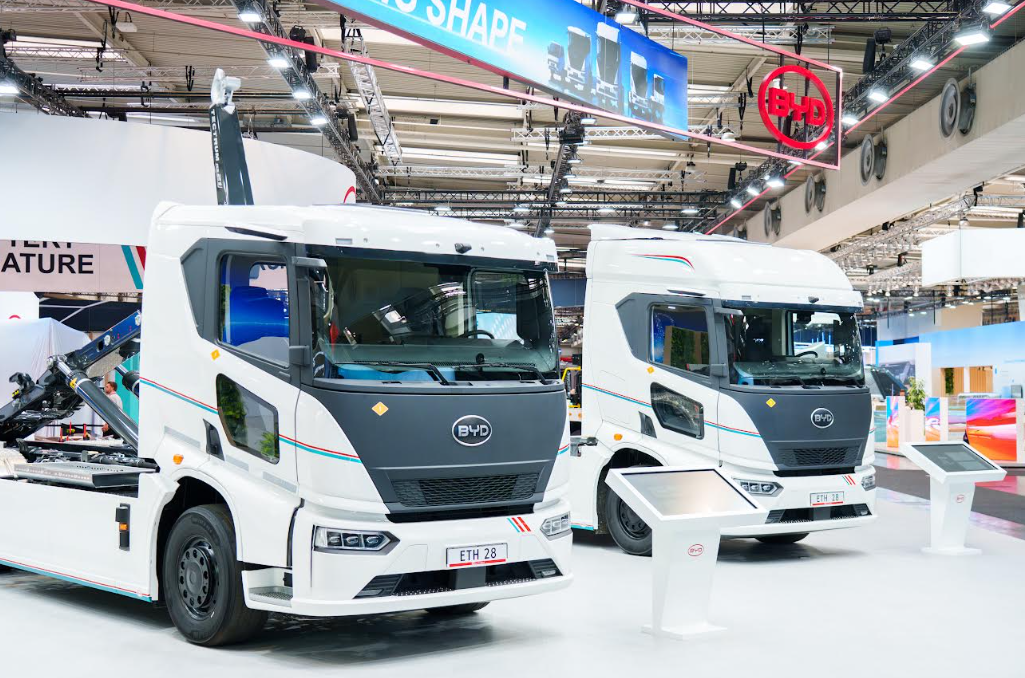
BYD unveiled a 44-metric-ton electric truck and commercial megawatt charging infrastructure at Germany's IAA Transportation show, marking the Chinese automaker's direct challenge to Europe's established heavy-duty vehicle manufacturers. The launch demonstrates BYD's expansion beyond passenger vehicles into the freight sector, where diesel trucks still dominate continental logistics networks.
The 44-metric-ton specification matches the maximum legal weight for tractor-trailer combinations across the European Union, allowing the vehicle to carry full commercial loads without regulatory restrictions. This payload capacity signals BYD's intent to compete directly on operational equivalence rather than as a niche alternative. The vehicle integrates battery technology that BYD manufactures in-house, reducing component costs compared to competitors reliant on external battery suppliers.
BYD's charging infrastructure announcement addresses the central barrier to electric truck adoption in Europe. Megawatt-level charging systems can replenish battery capacity in 30 minutes or less, critical for freight operations where downtime directly reduces profitability. Most European commercial charging networks operate at far lower power levels. BYD's push into charging infrastructure mirrors its existing integrated manufacturing strategy in passenger vehicles, where the company controls battery production, vehicle assembly, and parts supply.
The IAA show appearance signals BYD's confidence in European market entry at a moment when traditional truck makers face regulatory pressure. The European Commission's truck CO2 standards require manufacturers to reduce emissions by 55 percent by 2030 compared to 2019 baselines. Diesel trucks cannot meet these targets without electrification. Volvo, Mercedes-Benz, and Scania have launched electric truck models, but production volumes remain limited and pricing exceeds diesel equivalents.
BYD already operates in Europe through commercial vehicle operations in Spain and other countries. The company shipped 574,822 new energy vehicles globally in 2023, with European sales growing through bus and taxi deployments. European truck adoption has moved slower than passenger vehicle electrification due to infrastructure gaps, higher up-front costs, and logistics operators' reliance on proven diesel reliability.
The timing reflects market dynamics favoring Chinese entrants. BYD's vertical integration produces cost advantages competitors struggle to match. The company's battery production capacity exceeded 500 gigawatt-hours annually by 2024, undercutting battery costs from Western suppliers. This manufacturing scale advantage applies directly to commercial vehicles, where battery costs comprise 40-50 percent of vehicle expense.
European truck makers face pressure on multiple fronts. Battery supply constraints continue despite expanded production. Labor costs in Western Europe exceed those in China significantly. Environmental regulations tighten while Chinese competitors flood markets with competitively priced alternatives.
BYD's commercial megawatt chargers require substantial electrical infrastructure investment from European governments and private operators. Installing charging networks across national borders involves coordination between countries with varying grid capacities and investment priorities. This infrastructure gap remains the primary obstacle to rapid freight electrification across the continent.
The launch tests whether European operators will adopt Chinese-built trucks at the speeds BYD anticipates. Logistics companies historically show preference for established brands with long-term service networks and parts availability. BYD must build dealer networks and maintenance infrastructure to compete effectively. Success requires not just superior products but logistics industry confidence in Chinese brands for mission-critical operations.