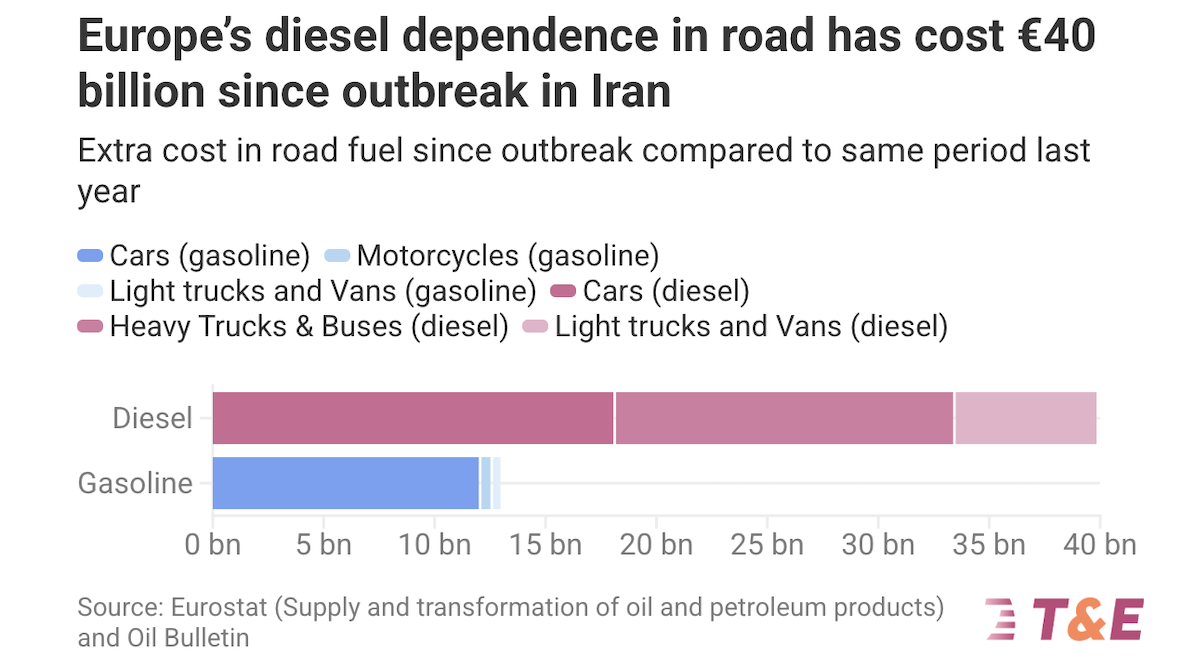
Europe faces a deepening diesel supply crisis that threatens economic stability across the continent. The bloc's dependence on diesel fuel, the highest among major developed economies, leaves it vulnerable to supply shocks from geopolitical disruptions and infrastructure failures.
Current market conditions expose this structural weakness. Diesel prices have climbed to record levels, driven by two converging factors: Middle East regional conflict disrupting global crude flows and Russian refinery outages eliminating a major supply source. Russia supplied roughly 10 percent of Europe's refined diesel before Western sanctions and military operations degraded its refining capacity. Simultaneously, tensions in the Persian Gulf region have tightened available supplies in global markets.
Europe's diesel dependency runs deeper than temporary market fluctuations. The continent consumes diesel at rates that exceed petroleum-dependent nations because freight transport, agriculture, and heating systems across Central and Eastern Europe rely on the fuel. Heavy-duty trucks account for roughly 30 percent of European transport emissions, and nearly all operate on diesel. This infrastructure lock-in creates structural demand that cannot shift quickly even when prices spike.
The economic consequences ripple across multiple sectors. Transportation companies absorb higher fuel costs or pass them to consumers through elevated shipping and logistics fees. Agricultural operations face squeezed margins as diesel inputs rise. Manufacturing competitiveness declines when energy costs increase relative to competitors in regions with more diversified fuel sources. Households in countries relying on diesel heating, particularly Poland, Hungary, and the Baltic states, face rising winter energy bills.
Supply disruptions arrive at a moment when European refineries already operate with limited spare capacity. The continent closed multiple refineries during the energy transition toward renewables, reducing refining redundancy. This narrowed buffer means supply shocks translate faster into price spikes and availability constraints.
Policymakers confront an uncomfortable reality. Short-term solutions remain limited. Strategic petroleum reserves can provide temporary relief but not sustained supply. Import arrangements with non-Russian suppliers exist but operate at lower volumes than lost Russian capacity. Long-term fixes require accelerating the transition away from diesel dependence entirely.
The European Commission has prioritized electrifying road transport and shifting freight to rail networks powered by renewable electricity. However, these transitions require years of infrastructure investment and vehicle fleet turnover. Heavy-duty trucking electrification remains nascent, with limited charging networks and battery technology still scaling. Alternative fuels like hydrogen and sustainable aviation fuel face similar delays.
This crisis underscores a paradox in Europe's energy transition. Renewable electricity deployment proceeds rapidly, yet transportation and heating remain tethered to fossil fuels. The continent reduced coal and nuclear generation faster than it replaced combustion engines. Geopolitical instability now exploits this gap.
The Middle East tensions and Russian sanctions likely persist, meaning diesel prices may stabilize at elevated levels rather than return to pre-crisis baselines. European economies must adapt to permanently higher energy costs while completing the transition to alternatives. Companies investing in electrification gain competitive advantage. Regions that fail to modernize transportation infrastructure face persistent cost disadvantages.