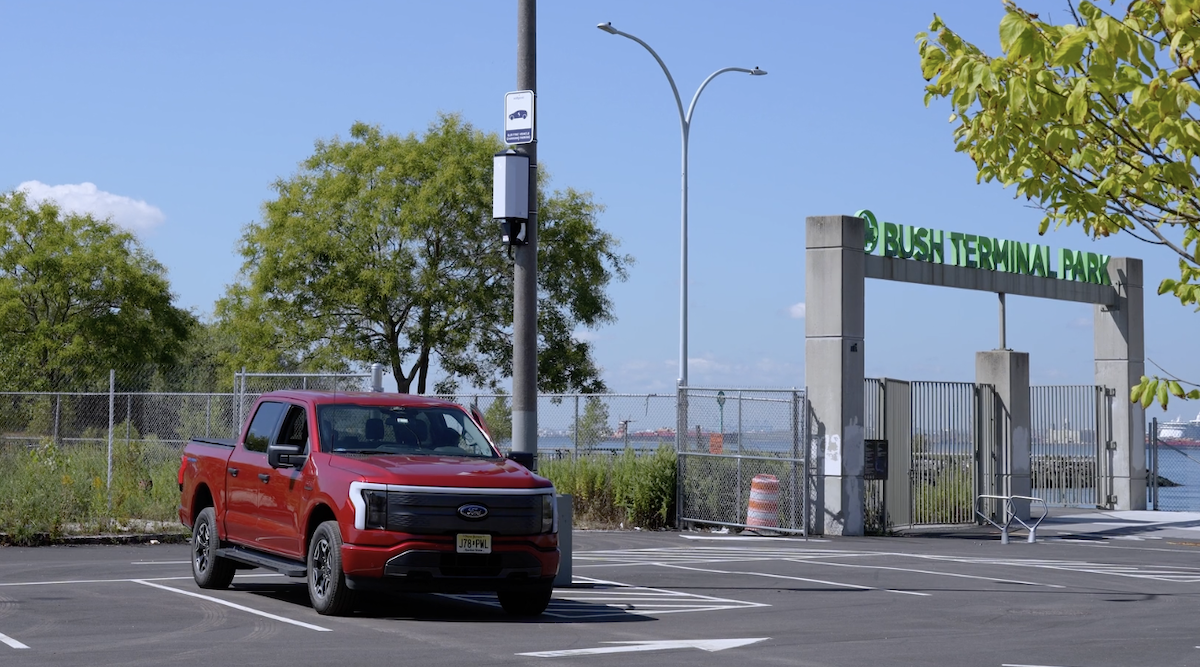
Voltpost, a US startup, is expanding deployment of EV charging infrastructure that leverages existing urban infrastructure like lampposts to bypass the installation bottlenecks that have slowed adoption in dense neighborhoods.
The company's approach addresses a persistent problem in American cities. Traditional EV charging stations require new electrical conduits, permits, and ground-level real estate that municipalities struggle to secure on congested streets. By retrofitting lampposts and existing curbside infrastructure, Voltpost eliminates months of construction delays and the high costs associated with cutting into pavement and running new utility lines.
The modular design allows rapid installation on existing poles and street furniture. This matters because urban charging remains severely undersupplied relative to demand. The Biden administration's Inflation Reduction Act allocated $7.5 billion for EV charging infrastructure, yet by 2024, deployment lagged projections. Cities like Los Angeles, San Francisco, and New York identified the lack of accessible residential charging as a major barrier to EV adoption, particularly for renters and apartment dwellers who cannot install home chargers.
Curbside charging networks have emerged as one viable solution, but they depend on dedicated street space and often compete with parking. Lamppost charging supplements this by using infrastructure already present on nearly every residential block. The electrical capacity already embedded in streetlight systems can support Level 2 and some Level 3 charging with minimal upgrades.
The approach aligns with urban planning priorities. Cities increasingly recognize that overnight charging at residential addresses will not solve last-mile transportation needs for urban residents without personal garages. Voltpost's model distributes charging points across neighborhoods rather than concentrating them at dedicated stations, reducing wait times and spreading grid load more evenly.
Deployment timelines favor lamppost integration. Where traditional installations required 6 to 12 months of permitting and construction, modular retrofits can complete in weeks once electrical connections are verified. This speed matters for municipal climate goals. Los Angeles aims for 1.4 million EV charging ports by 2035, New York targets 850,000, and San Francisco requires new buildings to include EV-ready infrastructure. Existing infrastructure solutions can accelerate these targets without proportional budgets.
Grid management becomes easier with distributed charging. Rather than drawing heavy current from a handful of fast-charging hubs, lampposts spread demand across the residential distribution network. This reduces strain on local substations and allows utilities to manage charging through time-of-use pricing, charging during off-peak hours when renewable generation peaks.
Technical limitations remain. Lamppost charging typically supplies Level 2 power, roughly 7 kilowatts, requiring 6 to 8 hours for a full charge. This suits overnight charging for commuters but not drivers needing rapid top-ups. Mixed infrastructure combining lampposts, curbside Level 2, and dedicated fast-charging depots represents the realistic near-term path for urban networks.
Voltpost enters a competitive market. Established players like EVgo and Electrify America operate national networks, though they focus on highway fast-charging. Curbside-specific operators like Volta Charging and others have secured municipal contracts in major cities. Voltpost's differentiation rests on installation speed and infrastructure reuse, advantages that matter most to cost-constrained city governments.
The company's scaling signals investor confidence in the distributed charging model. As EV adoption accelerates, the constraint shifts from vehicle availability to charging accessibility. Infrastructure retrofitting on existing urban assets offers faster deployment than ground-up construction, directly addressing why many urban drivers remain hesitant about purchasing EVs.