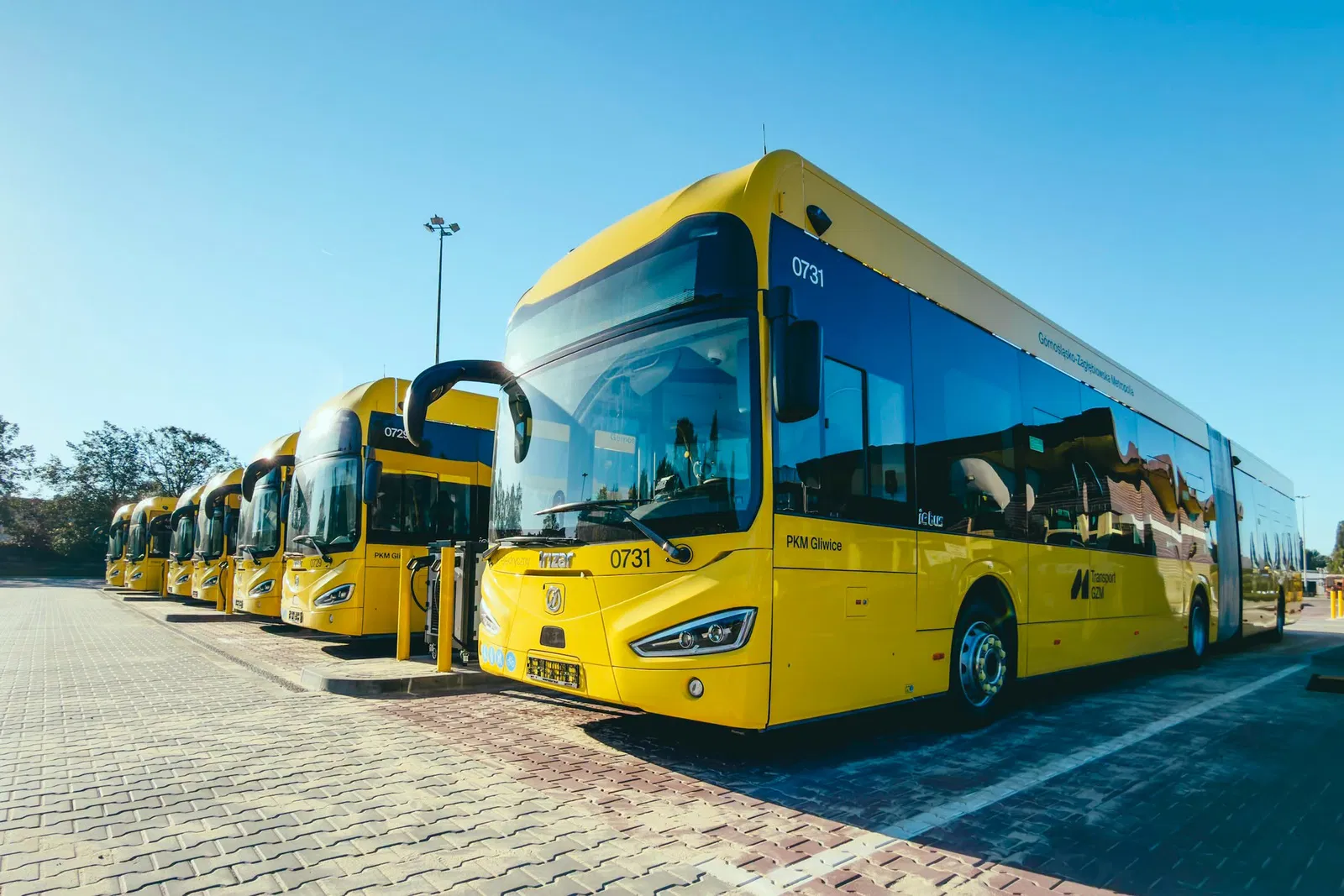
Spain's Irizar e-mobility has completed delivery of 31 battery-electric buses to Górnośląsko-Zagłębiowska Metropolia (GZM), the metropolitan transit authority serving Poland's Upper Silesian region. GZM accepted the Irizar ie buses technically and presented the fleet in July, marking a substantial expansion of electric public transportation in one of Poland's largest urban centers.
Upper Silesia, centered on the cities of Katowice and Zabrze, ranks among Europe's historically coal-dependent industrial zones. The region's air quality has long reflected that legacy, with particulate matter and nitrogen oxide concentrations regularly exceeding EU air quality standards. The 31-bus deployment directly addresses this pollution burden. Each electric bus eliminates direct tailpipe emissions and reduces particulate matter that diesel vehicles generate during combustion and brake wear.
The Irizar ie buses feature battery-electric powertrains designed for urban duty cycles. The vehicles operate on battery capacity sufficient for typical daily routes in metropolitan networks, with depot charging infrastructure supporting overnight turnaround. Poland has accelerated bus fleet electrification over the past five years, driven partly by EU funding mechanisms and air quality directives that penalize member states exceeding pollution thresholds.
GZM's network covers approximately 1.5 million residents across multiple municipalities in the Silesian Voivodeship. The transit authority operates hundreds of buses on regional routes. This order represents meaningful progress toward fleet decarbonization but remains partial. Most regional bus networks in Central and Eastern Europe still rely on diesel or natural gas vehicles. Poland's transport sector generated 122 million tonnes of CO2-equivalent emissions in 2021 according to Eurostat, with road transport accounting for roughly 96 percent of that total.
Irizar e-mobility, a subsidiary of the Irizar Group based in Spain's Basque Country, manufactures electric buses for European markets. The company has delivered vehicles to transit systems across Spain, France, and Germany. This Polish contract expands Irizar's footprint in Central European markets where bus electrification remains nascent compared to Western Europe.
The buses' environmental benefit depends on Poland's electricity grid composition. Poland's power generation relied on coal for approximately 71 percent of output in 2022, substantially higher than the EU average of 16 percent. This means the buses' operational emissions are higher than they would be in countries with renewable or nuclear-heavy grids. However, even coal-powered electricity typically produces lower emissions per kilometer than diesel buses when accounting for generation efficiency and transmission losses. Poland's renewable capacity has grown, with wind and solar reaching roughly 25 percent of generation in 2024.
GZM's bus deployment aligns with Poland's National Energy and Climate Plan commitments to reduce transport emissions. The European Union's Clean Vehicles Directive mandates that public procurements include minimum percentages of zero-emission buses, creating market demand that manufacturers like Irizar supply.
Maintenance costs for electric buses remain lower than diesel equivalents over their operational lifespan, lacking oil changes, spark plugs, and frequent transmission service. However, battery replacement at end-of-life presents both cost and recycling challenges that Poland's waste management infrastructure is only beginning to address systematically.
The GZM network now operates one of Poland's largest concentrated electric bus fleets, positioning Upper Silesia as a test case for large-scale electrification in coal-region economies.