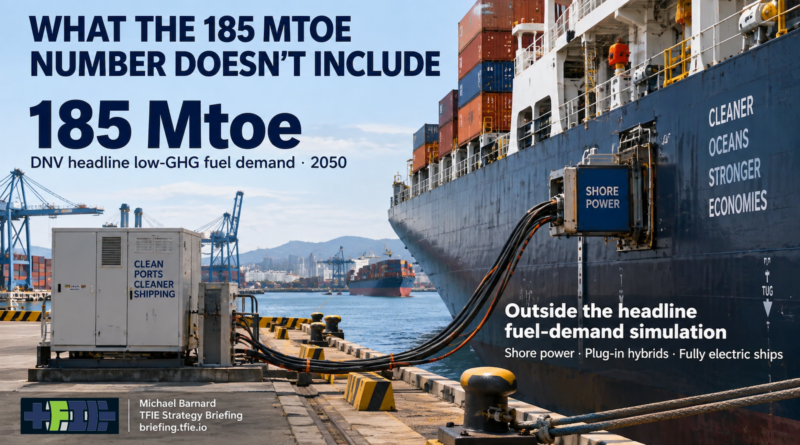
DNV, a classification society and shipping industry authority, published a 2050 Maritime Forecast projecting that international vessels above 400 gross tonnes will demand approximately 185 million tonnes of oil equivalent in low-greenhouse-gas fuels annually by 2050 under its strongest global-regulation scenario. This translates to roughly 7.7 to 7.8 exajoules of energy, a staggering volume that underscores shipping's dependency on alternative fuels rather than electrification.
The forecast reveals a critical gap in the shipping industry's decarbonization strategy. DNV's modeling assumes heavy reliance on sustainable marine fuels, synthetic fuels, and hydrogen-based solutions to meet 2050 climate targets. Yet the analysis marginalizes direct electrification, a technology gaining traction in other transport sectors. For ocean-going vessels, battery-electric propulsion remains technically limited by vessel size, operational range, and energy density requirements. Most large cargo ships operate on multi-week voyages across thousands of kilometers, making battery systems impractical at current technology levels.
This energy demand figure matters because it shapes policy, investment, and infrastructure development across the maritime sector. The International Maritime Organization has set a target of reducing shipping emissions by 50 percent by 2050, measured against 2008 baseline levels. Achieving this goal requires either dramatic fuel switching or operational efficiency gains. DNV's forecast assumes the former dominates, signaling that ports, refineries, and fuel suppliers must rapidly scale production of low-carbon alternatives.
The 185-million-tonne projection reflects only internationally operating ships, excluding domestic fleets and smaller vessels. Many countries operate regional shipping networks powered by conventional bunker fuel, creating a parallel decarbonization challenge unaddressed in DNV's model. Developing nations particularly lack capital for fuel infrastructure transition, potentially widening the compliance gap between developed and developing maritime hubs.
Synthetic fuels and ammonia feature prominently in DNV's scenario planning. Ammonia production currently generates massive CO2 emissions from hydrogen reforming, though green ammonia produced via electrolysis offers zero-carbon potential if renewable electricity feeds the process. Sustainable biofuels derived from waste streams present another pathway, though scaling capacity to meet 185 million tonnes annually faces feedstock constraints and land-use concerns.
DNV's framework assumes regulatory frameworks tighten globally. The EU's proposed FuelEU Maritime regulation and similar national schemes aim to force fuel decarbonization through carbon pricing and efficiency standards. Without such mandates, shipping companies lack economic incentive to adopt expensive low-carbon fuels. Current marine fuel premiums for decarbonized options range from 20 to 50 percent above conventional bunker costs, creating competitive disadvantages for early adopters.
The forecast's exclusion of electrification reflects realistic constraints but raises questions about model completeness. Short-haul regional routes, port operations, and harbor tugboats represent segments where battery-electric systems operate effectively today. Expanding electrification in these niches could reduce overall demand for synthetic fuels, though the vast majority of shipping energy consumption comes from long-distance oceangoing trade.
DNV's analysis serves as the baseline for industry planning and government policy design. Shipping represents approximately 2.7 percent of global CO2 emissions, with that share rising if other sectors decarbonize faster. Meeting the 185-million-tonne fuel demand requires coordinated investment in hydrogen production capacity, ammonia synthesis plants, biofuel refineries, and storage infrastructure. The next decade determines whether the maritime sector achieves this transition or becomes increasingly stranded between climate commitments and operational reality.