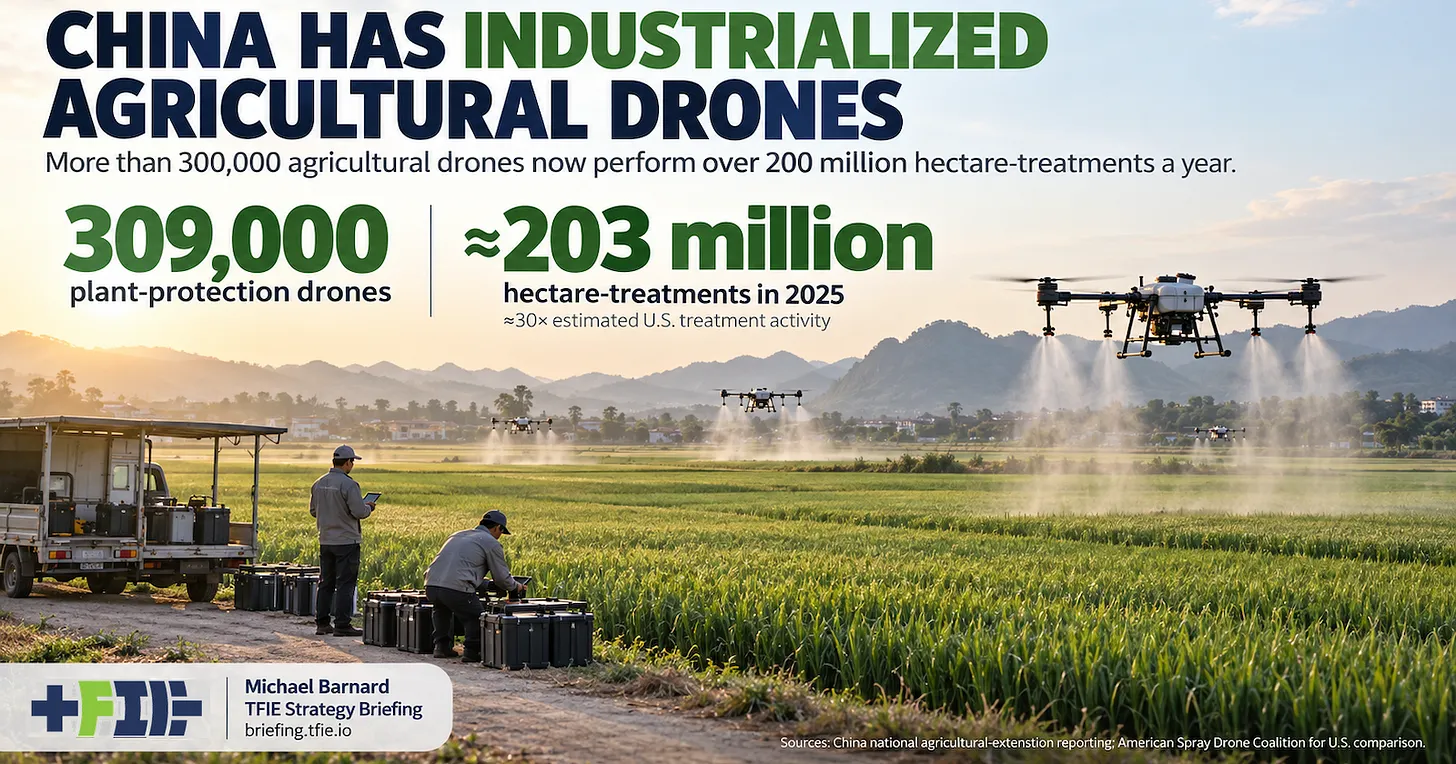
China operates roughly 309,000 agricultural spray drones that completed approximately 203 million hectare-treatments during 2025, according to data compiled by CleanTechnica. The figure dwarfs U.S. deployment by a factor of 30, establishing agricultural drones as routine farm machinery across China rather than experimental technology.
One hectare treated counts as one treatment unit. If a single drone sprays the same field three times in a season, that registers as three hectare-treatments. The 203 million figure therefore reflects total application volume rather than unique area covered. The scale underscores how thoroughly drone spray systems have integrated into Chinese agricultural operations.
The United States, by contrast, operates approximately 10,000 agricultural drones, conducting roughly 6 to 7 million hectare-treatments annually. This gap reflects different adoption timelines, regulatory environments, and agricultural structures. China's centralized government, vast rural labor shortages, and mechanization priorities created conditions for rapid drone deployment. U.S. regulations moved more cautiously. The Federal Aviation Administration (FAA) established part 137 exemptions for agricultural drones beginning in 2015, but approval timelines slowed widespread adoption relative to China's faster rollout.
Agricultural spray drones target crops with pesticides, herbicides, and fertilizers. They offer advantages over ground equipment and manned aircraft. Drones reduce chemical volume by up to 90 percent compared to traditional methods, lower labor costs in regions facing farmworker shortages, and access terrain inaccessible to ground equipment. They also enable precision application, reducing runoff into waterways and limiting exposure to nearby non-target vegetation.
China's drone manufacturers dominate global markets. DJI Agras, the agricultural division of DJI (Da-Jiang Innovations), leads production. DJI Agras drones spray fields in more than 40 countries. The company manufactures battery-electric and fuel-powered models ranging from 10-kilogram to 55-kilogram payload capacity. Battery systems enable electric operation with zero emissions per flight, though grid electricity sources determine overall carbon footprint.
The disparity between Chinese and U.S. drone counts reflects broader mechanization trends. China faces rural population decline as workers migrate to cities. Farms require labor-saving equipment. Drones solve this by automating spray work that otherwise demands hand-applied chemicals or expensive hired labor. The U.S. agricultural sector, historically reliant on immigrant labor and established equipment networks, adopted drones more gradually despite their efficiency gains.
U.S. regulatory barriers persist. The FAA restricts beyond-visual-line-of-sight (BVLOS) operations, which drones need for large-scale commercial applications. Individual waivers grant exemptions case-by-case, creating administrative overhead. China permits broader BVLOS operations under less restrictive frameworks. This regulatory difference accelerates Chinese deployment.
Climate considerations add weight to drone adoption patterns. Agricultural chemical runoff pollutes water systems and contributes to dead zones in rivers and coastal areas. Precision spray systems reduce this contamination. As climate pressures intensify water scarcity, reducing chemical and water waste becomes economically necessary alongside environmental benefits.
The 30-fold gap will likely narrow as U.S. regulations evolve and manufacturing scales up. However, China's head start in deployment volume, pilot experience, and domestic manufacturing capacity positions it as the agricultural drone leader for the foreseeable future. This technical dominance translates to data advantages, cost reductions, and export market control that compound over time.