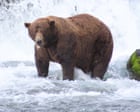
# Fat Bear Week Returns to Katmai as Salmon Runs Support Brown Bear Population Recovery
Katmai National Park's annual Fat Bear Week begins Monday, marking the 12th consecutive year of public voting on Alaska's heaviest brown bears. The week-long event coincides with the salmon run at Brooks River, where bears gather to feed before winter hibernation.
The timing of Fat Bear Week reflects a documented ecological reality: salmon abundance directly correlates with bear body condition and survival rates. During peak feeding season, individual bears can consume up to 90 pounds of salmon daily, enabling rapid weight gain necessary for surviving months without food. The public voting mechanism, while lighthearted, tracks a serious biological metric. A bear's pre-hibernation weight determines its metabolic demands during denning and influences cub survival rates for nursing females.
Katmai's brown bear population has stabilized at approximately 2,100 individuals, making it one of North America's healthiest large predator populations. This recovery stems partly from the 1980 establishment of the park and subsequent protection of critical salmon-bearing watersheds. The Brooks River watershed alone supports feeding concentrations of up to 140 bears simultaneously during July and September peaks.
Fat Bear Week engages public participation in wildlife monitoring while educating participants about predator-prey dynamics and climate impacts on salmon runs. The Katmai Foundation and National Park Service use voting data to increase public engagement with conservation science. Previous winners have included Bear 435 (known as "Otis"), a dominant male weighing over 1,400 pounds, and more recently, female bears whose reproductive success depends on accessing sufficient salmon calories.
Climate change poses an emerging threat to this ecosystem balance. Warmer water temperatures alter salmon migration timing and abundance, potentially disrupting the synchronized feeding window bears rely on. Research from the University of Washington and the U.S. Geological Survey documents phenological mismatches in some Alaska systems where bears arrive at rivers before peak salmon runs occur. Katmai's salmon populations remain robust currently, but long-term monitoring programs track whether warming trends will compress feeding windows or reduce overall salmon productivity.
The Brooks River live camera feeds that enable Fat Bear Week voting also serve research purposes. Scientists use video archives to document bear behavior, individual identification, and population demographics. Data collected since the 1990s provides baseline information for detecting future population changes.
Female bears entering hibernation with insufficient fat reserves face increased mortality rates and reproductive failure. Cubs born during denning depend entirely on maternal fat reserves for survival through spring emergence. The competitive feeding hierarchies visible during salmon runs directly reflect individual bears' survival prospects. Dominant males monopolize prime fishing locations, while younger bears and females with cubs feed in peripheral zones where salmon are less concentrated.
Fat Bear Week voting runs through the National Park Service website and generates significant media attention. Previous contests have attracted hundreds of thousands of votes from international participants. The event humanizes wildlife management while communicating the connection between salmon productivity, bear fitness, and ecosystem health.
Park officials monitor salmon spawning success, water temperatures, and bear movements through year-round field research. These datasets inform decisions about visitor access to Brooks River and resource allocation for bear habitat protection. As climate impacts on salmon runs become more pronounced across Alaska, Katmai's stable populations provide a reference point for understanding how intact ecosystems respond to environmental change.