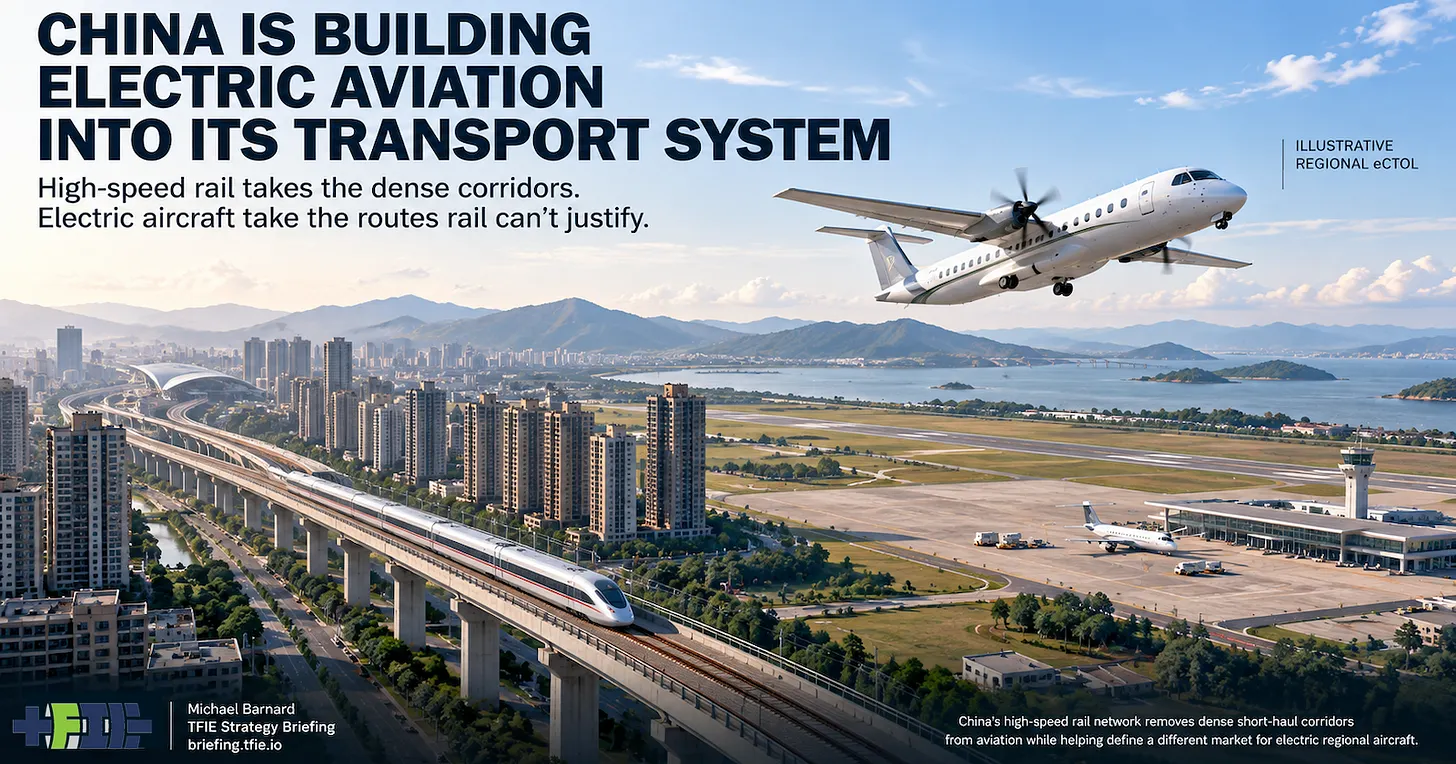
China has reframed the electric aviation competition from a race between individual aircraft manufacturers to a buildout of integrated transport infrastructure, a shift that positions the nation ahead of competitors focused on prototype development and certification milestones.
The distinction matters because a single successful flight or regulatory approval demonstrates technological feasibility. Building an industry requires scaling production, establishing charging networks, training pilots and mechanics, integrating aircraft into existing airport operations, and creating supply chains for batteries and components. China has invested in all of these simultaneously rather than betting on breakthrough aircraft designs alone.
Chinese manufacturers including COMAC and emerging electric aviation startups operate within a national strategy that treats electrified transport as a systems problem. This approach mirrors China's deployment of renewable energy infrastructure. When China builds solar or wind capacity, officials simultaneously upgrade grid infrastructure, establish manufacturing hubs for components, and coordinate logistics across provinces. The same playbook applies to aviation.
Western aviation companies and startups tend to concentrate resources on perfecting individual aircraft. Eviation, Joby Aviation, Lilium, and others have pursued type certification from the Federal Aviation Administration or European Union Aviation Safety Agency. These certifications prove an aircraft meets safety standards. They do not prove a company can deliver dozens of units annually or maintain a fleet economically.
China's electric aviation advantage rests on several structural factors. State-owned enterprises can access subsidized financing and secure long-term orders from state-controlled airlines and regional carriers. Manufacturing capacity in battery production gives Chinese firms control over a critical bottleneck. Domestic demand from crowded regional routes creates immediate markets for short-haul electric aircraft, reducing the need for exports to achieve scale.
Regional routes present the optimal near-term use case for electric aviation. Flights under 500 kilometers consume less energy and fit battery range constraints better than long-haul travel. China operates hundreds of regional air routes between cities where congestion and air quality concerns create political pressure to adopt cleaner transport. Airlines flying these routes face regulatory incentives to electrify.
The FAA and European regulators have not yet approved commercial electric aircraft for revenue passenger service. Development timelines stretch across five to seven years for certification. During this period, China can accumulate operational experience, refine supply chains, and reduce costs through volume production. By the time Western manufacturers enter service, Chinese competitors will have optimized operations across fleets, not prototypes.
Environmental benefits depend entirely on achieving scale. One electric aircraft reduces emissions. Hundreds operating daily across a region reshape air quality and carbon profiles for transportation. China's transport-system approach targets the latter outcome immediately rather than treating it as a distant consequence of prototype success.
The competitive advantage extends beyond manufacturing. Pilot training programs, maintenance protocols, airport charging infrastructure, and battery recycling systems all require development. Companies or nations that build these systems first capture learning curves that later entrants cannot match. China's willingness to treat electric aviation as infrastructure rather than product development gives it momentum that prototype-focused competitors have not yet accumulated.