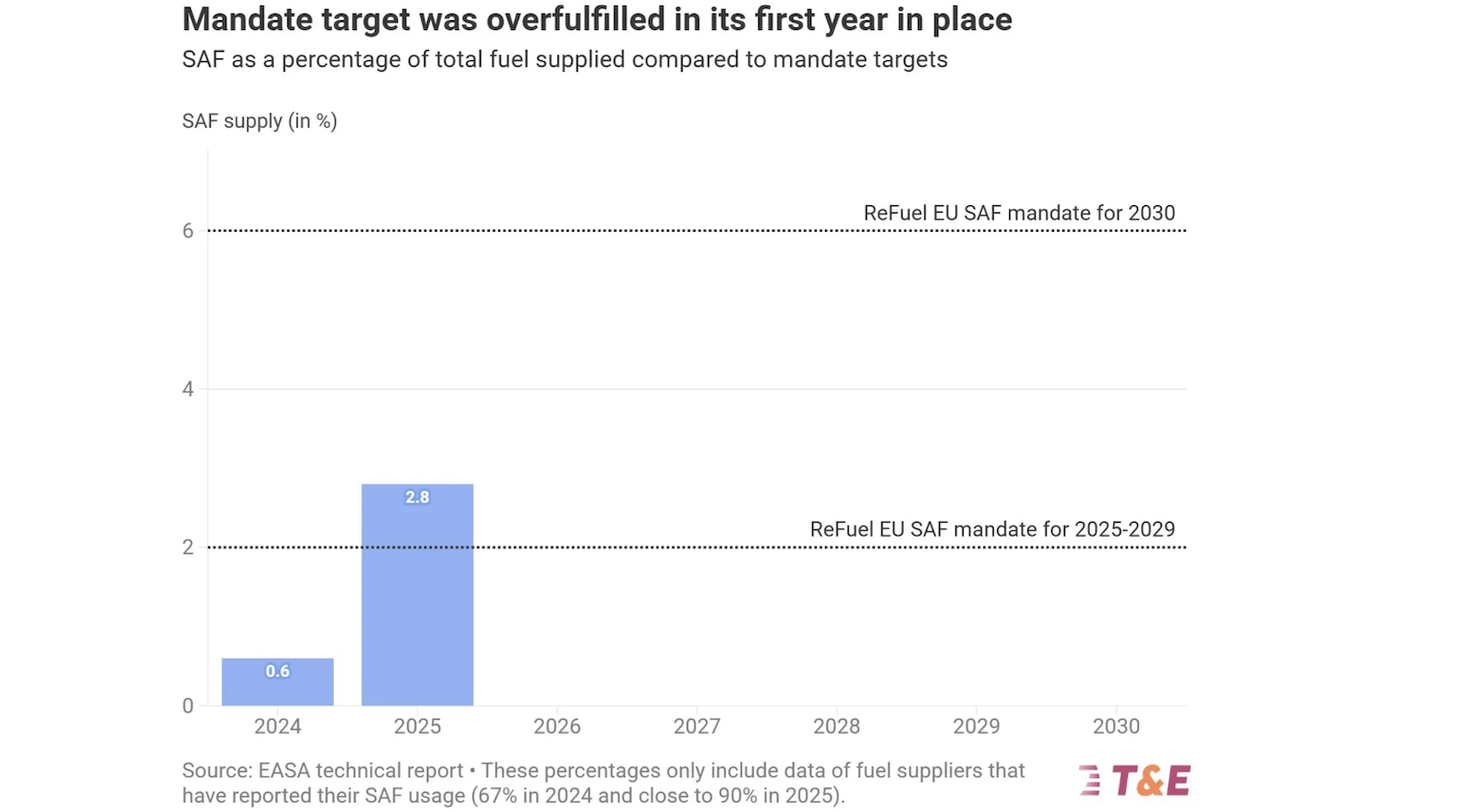
The European Union Aviation Safety Agency released its first annual technical report on ReFuelEU Aviation, confirming that mandatory sustainable aviation fuel (SAF) targets are functioning as intended. The regulation, which entered into force in 2025, requires EU airlines to blend increasing percentages of SAF into jet fuel supplies. The EASA report documents the market's initial response and identifies next steps for scaling production.
ReFuelEU establishes binding blending mandates that begin at 2 percent in 2025 and rise to 70 percent by 2050. These targets apply to all flights departing from EU airports, regardless of airline nationality. The regulation covers conventional SAF produced from waste oils and residues, as well as emerging synthetic fuels known as e-SAF, which are manufactured from renewable electricity and captured carbon dioxide.
The EASA's 2025 annual report provides the first comprehensive data on how airlines and fuel suppliers responded to the mandate's initial requirements. The findings demonstrate that producers ramped up SAF supply to meet the blending obligation, validating the regulatory approach. This outcome matters because the aviation sector accounts for approximately 2.4 percent of global carbon dioxide emissions. Decarbonizing jet fuel is essential to meeting the European Green Deal's goal of climate neutrality by 2050.
However, the report flags a critical bottleneck. E-SAF production remains minimal despite its long-term importance. E-SAF offers substantially higher emission reductions than conventional SAF because it uses renewable electricity rather than biomass feedstocks. The EU estimates e-SAF can cut lifecycle emissions by up to 80 percent compared to fossil jet fuel. Conventional SAF achieves reductions of 50 to 80 percent depending on feedstock source.
The barrier to e-SAF scaling is investment. These fuels require dedicated production facilities and stable power supplies, typically from wind or solar installations. Capital costs are steep, and producers need long-term contracts guaranteeing fuel purchase at prices that cover production expenses. Airlines currently face higher SAF costs; sustainable fuel premiums range from 20 to 80 percent above conventional jet fuel prices depending on production method and feedstock availability.
EU policymakers are exploring mechanisms to unlock e-SAF financing. The European Commission has signaled support for blending requirements that specifically mandate e-SAF percentages separate from broader SAF targets. Such requirements would signal sustained demand and justify project investment. Germany, which leads EU hydrogen strategy, has begun mapping e-SAF production sites and power availability.
Private investment also shows early momentum. Several European energy companies and startups announced e-SAF projects in 2025. Nouryon, a specialty chemicals company, committed to developing large-scale e-SAF production in the Netherlands. Sustainable aviation fuel suppliers including Neste and World Energy are expanding output to meet current demand while investing in synthetic fuel capacity.
The ReFuelEU mandate's early success demonstrates that regulatory certainty drives market transformation. Fuel suppliers met 2025 blending targets ahead of schedule, proving that mandatory targets function as intended. The next phase requires converting regulatory success into technology breakthrough. E-SAF investment decisions hinge on policy clarity and financial mechanisms that bridge the cost gap between synthetic fuels and fossil alternatives. The EASA report establishes the baseline for measuring whether Europe can sustain momentum toward 2050 climate targets.