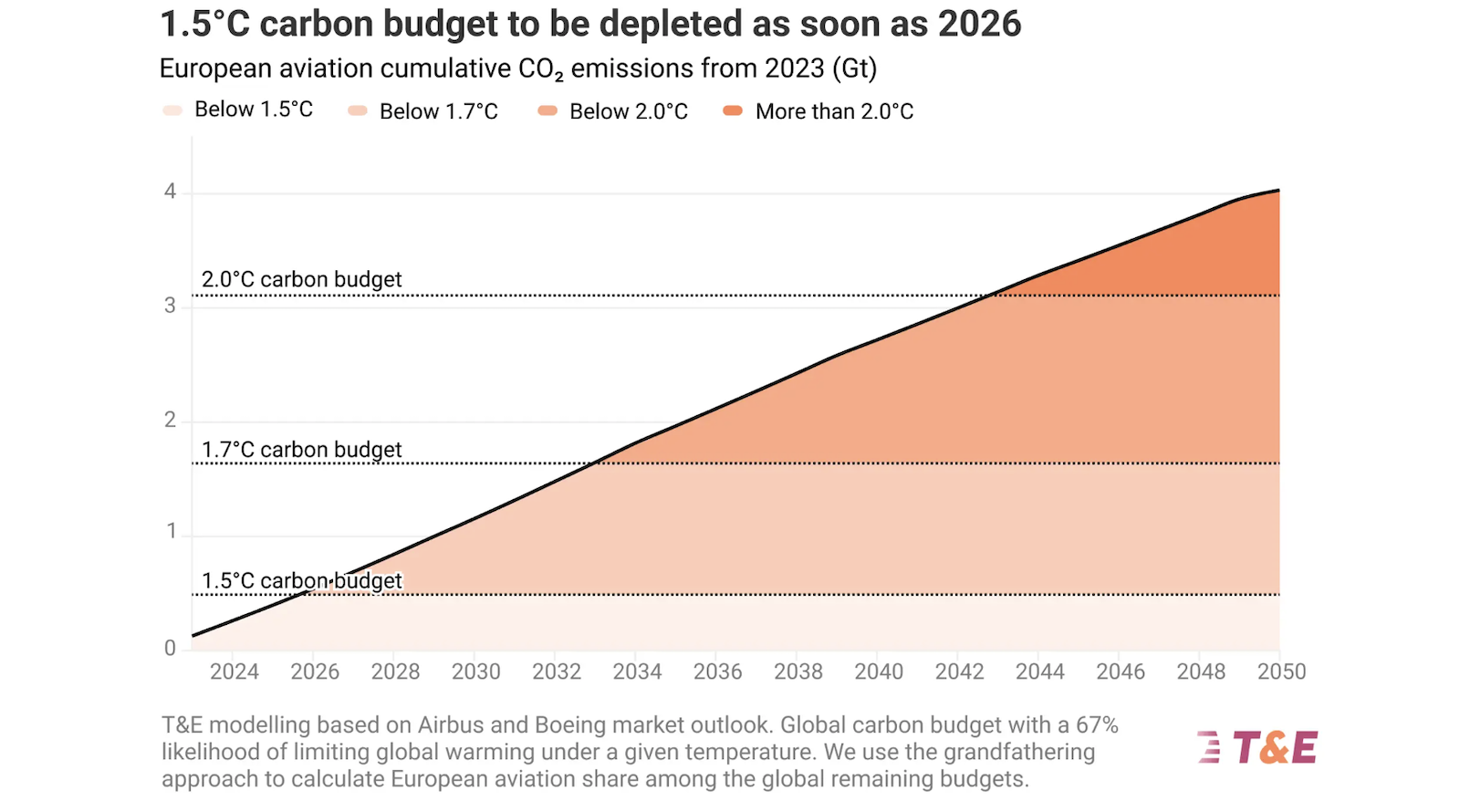
European airports are racing toward climate catastrophe. A new Transport and Environment (T&E) study documents that expansions at twenty of Europe's largest airports will burn through their carbon budgets by up to 300 percent. These airports cannot expand without breaking Paris Agreement commitments.
T&E, a Brussels-based transport advocacy organization, modeled the emissions trajectory of major European airport expansion projects against the carbon budgets needed to limit warming to 1.7 degrees Celsius. The analysis reveals a systemic mismatch. Planned terminal expansions, new runways, and capacity increases at airports across the continent assume growth that climate physics cannot absorb.
The study names specific airports and projects. It quantifies their individual carbon budgets against their planned passenger growth rates. Major European hubs including Frankfurt, Amsterdam, Paris, and London feature in the analysis. Each shows the same pattern. Airport operators project passenger increases of 30 to 50 percent over the next fifteen years. Their carbon allocations under national climate law permit nothing of the sort.
The legal framework tightens the trap. European Union member states have locked in emissions reduction targets under the Fit for 55 directive and the Climate Change Act framework. These targets require economy-wide cuts of 55 percent by 2030 compared to 1990 levels. Aviation counts toward those targets. So does ground transport serving airports, fuel production, and airport construction itself. When planners model airport expansions in isolation, they ignore that every added flight steals carbon headroom from electricity grids, heating systems, and industrial processes elsewhere in national accounts.
T&E's methodology applies the 1.7-degree carbon budget framework established by the Intergovernmental Panel on Climate Change (IPCC) in its 2021 assessment reports. That budget represents the remaining carbon space for aviation if humanity avoids catastrophic warming. T&E converted that global figure into per-country and per-airport allocations. The arithmetic is brutal. European airports already consume roughly 3 percent of the EU's total emissions. Expanding them by 40 percent while cutting overall emissions by 55 percent becomes mathematically impossible without massive technological shifts that remain speculative.
Airport operators point to sustainable aviation fuel (SAF) mandates and aircraft efficiency improvements. EU regulations now require 2 percent SAF blending by 2025, rising to 70 percent by 2050. But T&E's models account for these trajectories and still find expansion incompatible with climate targets. SAF cannot scale fast enough. Production remains constrained. Costs stay prohibitive. Aircraft efficiency gains trail demand growth.
The policy response remains absent. Most European governments have not applied hard carbon caps to airport expansion. Instead, they issue environmental permits based on local air quality and noise standards, not climate compatibility. This regulatory gap allows airports to plan as though climate constraints do not exist.
Several smaller European airports have frozen expansion plans in recent years under climate pressure. But major hubs, facing post-pandemic recovery pressures and competitive anxiety, push forward. They lobby governments for rail improvements and ground transport while simultaneously planning runway extensions that generate the emissions rail cannot eliminate.
T&E calls for hard carbon budgets in airport licensing. Governments must set maximum carbon footprints for each airport based on national climate targets, then issue no new permits that breach those caps. Expansion becomes possible only if airports retire equivalent aviation capacity elsewhere or decarbonize at rates matching growth. Neither scenario appears likely under current policy frameworks.