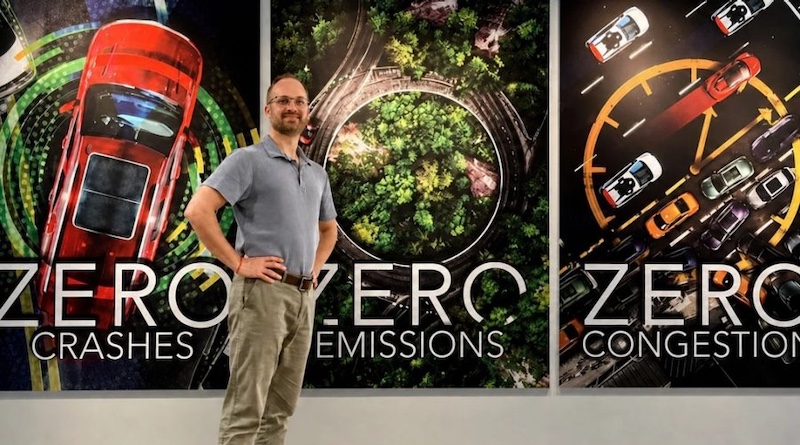
Taylor Searcy, a former Navy officer, now shapes General Motors' clean energy strategy, translating military systems thinking into corporate decarbonization efforts. His career trajectory illustrates how defense sector expertise applies to the automotive industry's transition away from internal combustion engines.
Searcy's background in naval operations exposed him to complex logistics, supply chain resilience, and long-term planning under constraints. These competencies transferred directly to GM's challenge of scaling electric vehicle production while managing energy infrastructure demands. The Navy operates a fleet that requires strategic fuel management and operational efficiency. Similar thinking now applies to EV battery supply chains, charging network deployment, and grid integration.
GM, headquartered in Detroit, faces mounting regulatory pressure and market competition in electrification. The company committed to full electric vehicle production by 2035 as part of broader industry net-zero pledges. That timeline demands coordinated strategy across manufacturing, supply sourcing, and infrastructure partnerships. Searcy's role involves translating those objectives into executable plans, drawing on military project management disciplines.
The military-to-corporate pipeline represents a growing trend in clean energy sectors. Veterans bring systems-level thinking developed through missions requiring coordination across multiple agencies and timelines. Defense experience also instills risk management practices essential for capital-intensive energy transitions. GM and other automakers increasingly recruit from military backgrounds for leadership roles overseeing electrification strategies.
Searcy's position at GM connects to broader industry evolution. Ford, Volkswagen, and Tesla all employ former military personnel in strategic roles. The U.S. Department of Defense itself ranks among the largest institutional energy consumers, driving its own decarbonization initiatives. That creates networks of expertise spanning public and private sectors.
GM's clean energy strategy encompasses multiple pathways. The company invests in renewable energy procurement for manufacturing facilities, battery plant development, and charging infrastructure partnerships. Searcy's work likely coordinates these initiatives with supplier networks and regulatory compliance. The automaker aims to reduce Scope 1 and Scope 2 emissions from operations by 60 percent by 2030, requiring detailed execution planning.
The clean energy sector increasingly values diverse talent pipelines. Veterans bring cross-functional collaboration skills, crisis response capabilities, and discipline around long-term planning. These competencies accelerate corporate transitions toward electrification and renewable energy adoption. Searcy exemplifies how defense sector experience translates into civilian climate action leadership.
GM operates 53 manufacturing facilities across North America. Transitioning those plants toward electric vehicle production while maintaining supply continuity demands the kind of operational complexity Searcy managed during Navy service. His experience navigating institutional bureaucracy, budget constraints, and mission-critical timelines directly applies to corporate energy strategy execution.
The story of Searcy and similar military-connected professionals highlights an often-overlooked resource in climate transition planning. The U.S. military has long invested in energy security, resilience, and efficiency. Those institutional learnings now benefit corporate decarbonization efforts. As automakers accelerate EV adoption and renewable energy integration, experienced systems thinkers from defense backgrounds shape implementation strategies that determine whether companies meet their climate commitments on schedule.