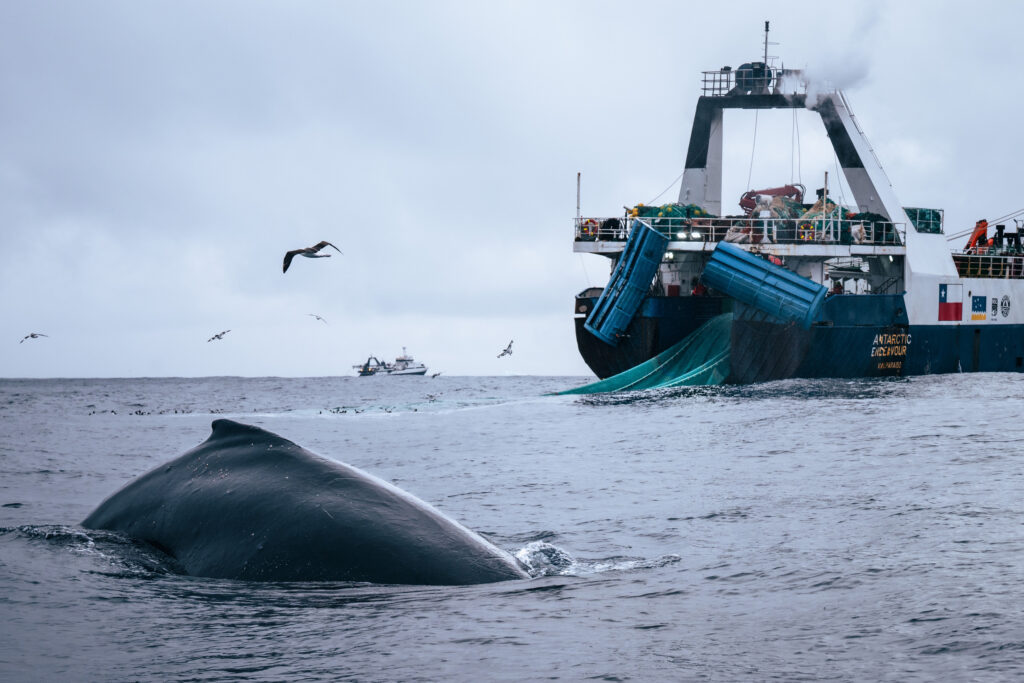
Antarctic whale populations have rebounded dramatically over the past four decades following the 1986 commercial whaling moratorium, but scientists now warn that expanding krill fishing operations threaten to reverse conservation gains by depleting the primary food source for baleen whales across the Southern Ocean.
For the second consecutive year, industrial krill vessels voluntarily ceased operations after hitting seasonal catch limits. The fleet targeted waters around the Antarctic Peninsula and South Orkney Islands, approximately 400 miles north of the peninsula. Yet this restraint masks a deeper concern. Krill, tiny crustaceans forming the base of Antarctic food webs, sustain humpback, fin, and blue whales as they rebuild populations decimated by twentieth-century industrial whaling.
The Commission for the Conservation of Antarctic Marine Living Resources, the regional body governing Southern Ocean fishing, sets annual krill catch limits. Current regulations allow up to 5.61 million tons annually, though fleets harvest far less. The real threat lies not in current catch levels but in the expansion of the krill fishing industry itself. Demand for krill-derived omega-3 supplements and aquaculture feed continues climbing in Asia and Europe. Vessels have grown more efficient. Technology improves. The economic incentives point toward increased extraction.
Whale recovery numbers tell the success story. Blue whale populations, hunted to near extinction with only around 5,000 remaining in the 1960s, now number approximately 25,000 across global oceans. Antarctic humpback whales rebounded from roughly 5,000 in 1966 to more than 25,000 today. These recoveries required three decades of protection and abundant food sources.
Research published by Antarctic scientists demonstrates that krill abundance directly correlates with whale feeding success and reproductive rates. In years when krill concentrations decline, whale calving rates drop measurably. Growing commercial pressure on krill stocks creates conditions where whales face renewed food scarcity precisely when their populations have become vulnerable again.
The tension centers on competing resource claims. Commercial fishing interests argue current catch limits provide sustainable harvesting. Conservation advocates counter that sustainability models fail to account for rapid climate change affecting krill distribution and abundance. Antarctic waters warm faster than global ocean averages. Warming shifts krill habitat patterns. Industrial vessels struggle to adapt to moving prey sources, potentially intensifying fishing pressure on remaining krill concentrations.
The South African company Aker Biomarine operates the world's largest krill harvesting fleet. The company argues its sustainability practices prevent overexploitation. Environmental organizations including Greenpeace push for expanded marine protected areas that would prohibit commercial fishing entirely across critical whale feeding grounds.
The Antarctic Treaty system, established in 1959, prohibited military activities but permitted resource extraction. This framework now faces its most serious conservation test since the whaling moratorium passed. Decision-making bodies move slowly. Commercial interests lobby effectively. Whale populations, though recovering, remain vulnerable to sudden food shortages.
Japan and Norway, both possessing whaling interests, hold voting power within Antarctic management bodies. Their positions on krill regulation reflect broader tensions between extractive industries and marine protection. The next five years will prove decisive. If krill fishing expands unchecked while climate changes accelerate, recovered whale populations could face renewed population declines despite formal protection from hunting.