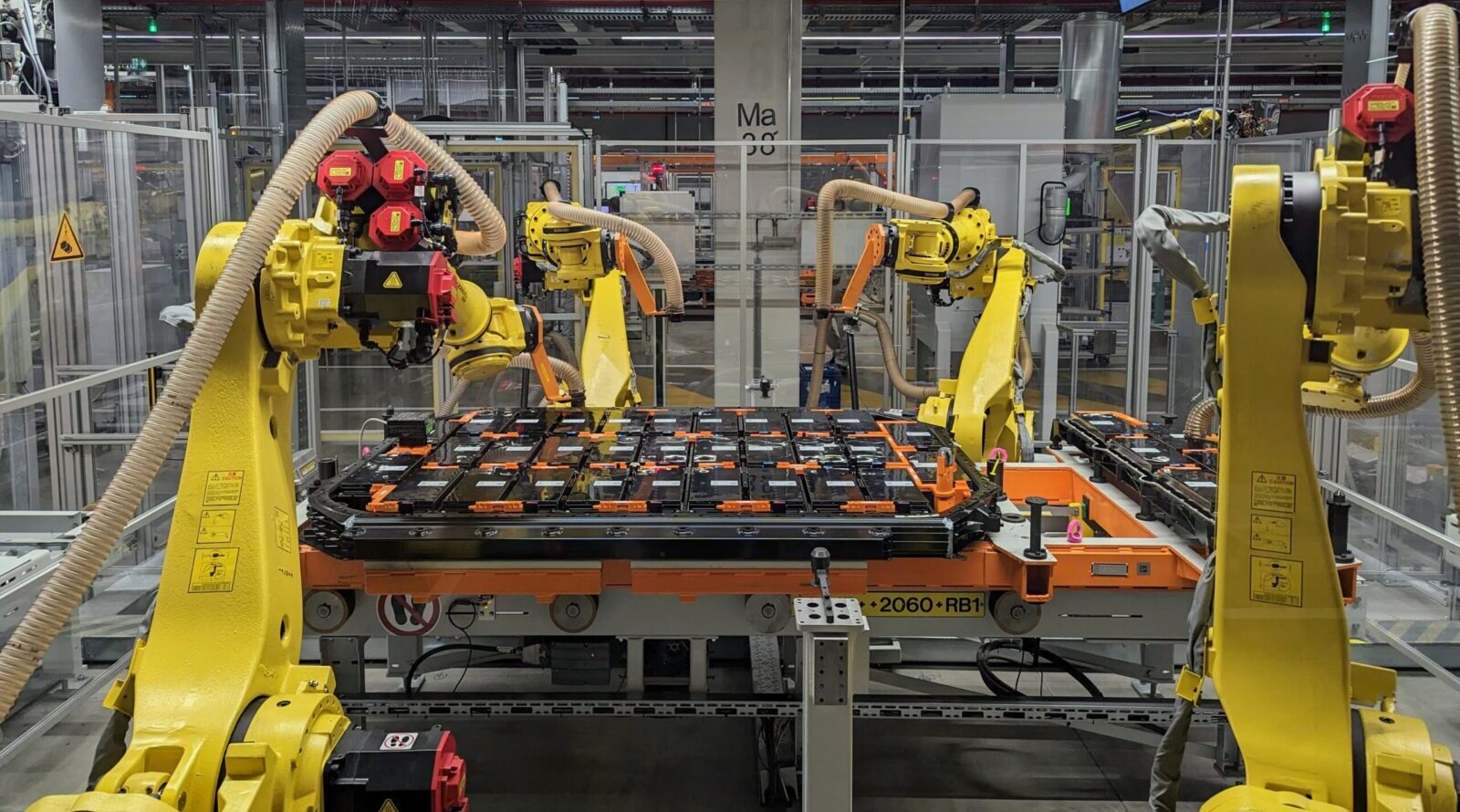
Europe faces a critical battery supply vulnerability that threatens its energy transition, industrial competitiveness, and military capabilities. The continent is rapidly deploying batteries across transportation, grid storage, and defense systems, yet produces almost none of the essential raw materials and components needed to manufacture them domestically. This dependency chain exposes Europe to geopolitical risk and supply disruptions while government subsidies prop up an underdeveloped battery sector.
The stakes are substantial. Batteries form the foundation of Europe's decarbonization strategy, enabling electric vehicles to replace fossil fuel cars and storing renewable energy when wind and solar generation fluctuates. The European Union has mandated all new cars be zero-emission by 2035, requiring massive battery production scaling. Grid-scale battery storage grows annually as wind and solar capacity expands. Beyond energy, military applications demand batteries for electric aircraft, drones, and naval vessels as NATO members modernize their arsenals.
Yet Europe produces virtually no lithium, cobalt, nickel, or manganese, the four minerals critical for lithium-ion battery chemistry. China controls roughly 80 percent of global battery cell manufacturing capacity and dominates processing of raw materials. This imbalance means Europe depends entirely on imports for the inputs that make its energy transition possible.
Public funding compensates for market failures. European governments and the EU have committed billions through the European Battery Innovation program, battery manufacturing grants, and green industrial policy frameworks. The European Commission's Net-Zero Industry Act targets 90 percent of EU battery needs from domestic production by 2030, a goal requiring sustained investment and technological breakthroughs that remain uncertain. Germany, Poland, and Sweden host most announced battery gigafactory projects, yet these facilities cannot achieve scale without secure mineral access.
Mining represents the first constraint. Lithium extraction from salars in Argentina, Chile, and Bolivia requires years of permitting and environmental review. European domestic lithium deposits in Portugal, the Czech Republic, and Germany remain underdeveloped. Cobalt sourcing raises human rights concerns in the Democratic Republic of Congo, where child labor and poor working conditions persist. Nickel mining creates environmental damage through water pollution and habitat loss in Indonesia and the Philippines.
The European Battery Regulation, implemented January 2023, mandates recycling targets and carbon footprint reporting. Recycling can recover 95 percent of cobalt and nickel from spent batteries, but scaling this infrastructure requires capital investment and technical expertise Europe is still building. Current recycling capacity covers only 5 percent of projected 2030 battery demand.
Geopolitical leverage compounds the risk. China has weaponized battery supply before, restricting exports of rare earth elements to pressure trading partners. Russia traditionally supplied palladium and other metals until sanctions disrupted those channels. Competition for African mineral concessions intensifies as the U.S., EU, and China all secure long-term supply agreements.
Europe's battery strategy requires three simultaneous shifts: securing long-term mineral supply contracts through diplomatic partnerships with resource-rich nations, accelerating domestic recycling infrastructure to reduce import dependency, and funding domestic mining operations despite environmental and social constraints. Without this integrated approach, Europe's electric transition becomes hostage to decisions made in Beijing and constrained by material scarcity rather than technological limits.