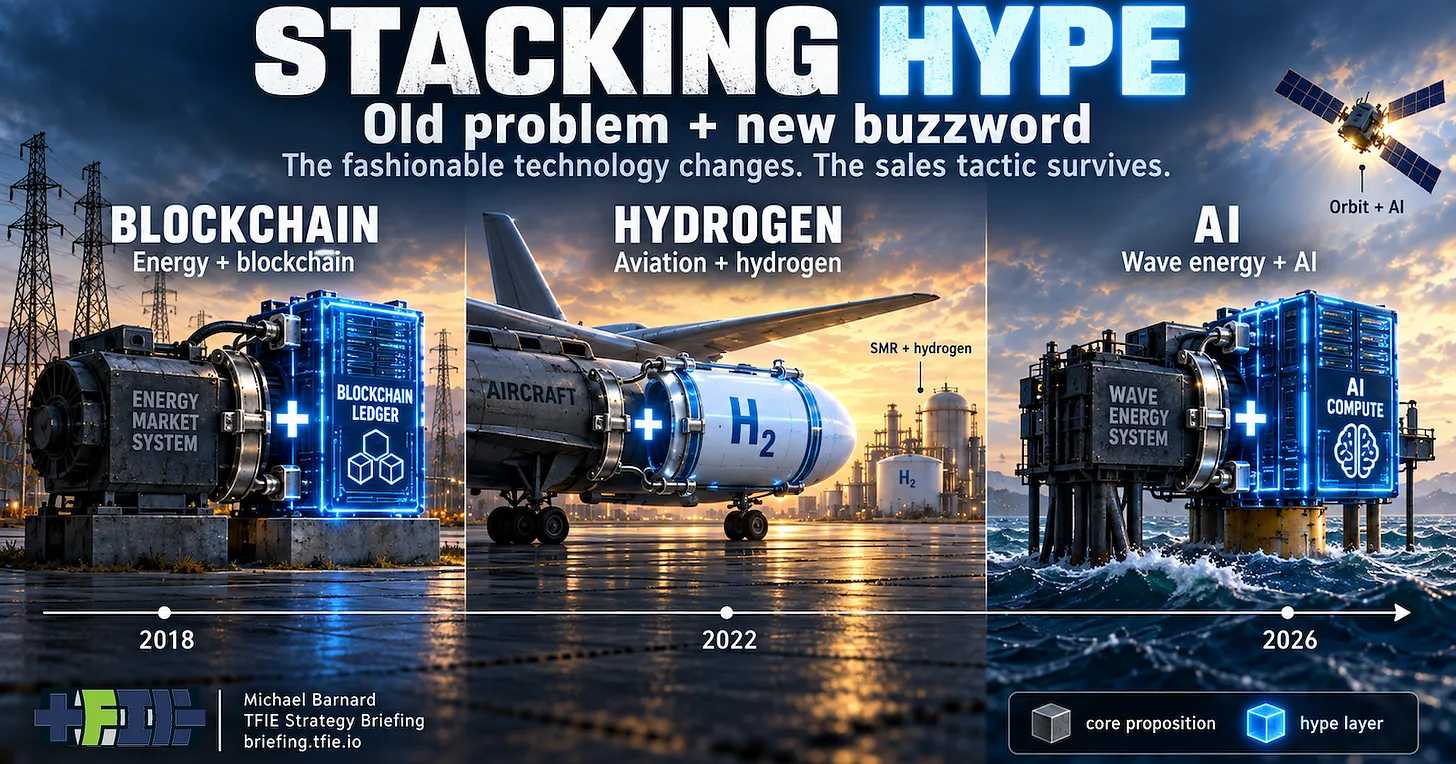
Panthalassa's $140 million funding round exemplifies a pattern overtaking climate technology investment: wrapping old problems in AI-adjacent solutions to attract capital in an overheated market.
The startup proposes autonomous ocean platforms that convert wave energy into electricity, then use that power directly for AI inference computing at sea. The pitch sidesteps a genuine engineering challenge that has plagued wave energy for decades. Subsea transmission cables and grid interconnection systems impose significant losses and costs on wave power projects. By computing at the source instead of sending electrons ashore, Panthalassa claims to eliminate infrastructure bottlenecks.
The logic holds water as engineering. Running AI workloads offshore does reduce transmission losses. Data centers consuming terawatts of power represent a genuine problem for decarbonization. Google and Microsoft have both committed to carbon-neutral operations by 2030, which means they need massive renewable capacity. If AI computation moves to where clean energy exists rather than importing that energy across fragile grids, the math works.
But the commercial obstacles facing wave energy remain unchanged by adding machine learning to the equation.
Wave energy has attracted billions in research funding over the past two decades. Projects from Pelamis Wave Power to Columbia Power Technologies to Aquamarine Power have failed or retreated from commercialization despite genuine technological progress. The reasons persist: harsh ocean environments corrode and break equipment faster than manufacturers anticipated. Maintenance costs in remote marine locations run higher than onshore wind or solar farms. Grid operators show limited enthusiasm for integrating variable wave power into their systems. Insurance rates for novel marine energy devices remain punitive.
Adding AI inference to the mix does not resolve equipment longevity or maintenance economics. An autonomous platform still requires regular servicing in salt spray and heavy seas. Scaling from one pilot installation to a fleet of dozens or hundreds involves supply chain problems and operational complexity that artificial intelligence cannot engineer away.
The narrative shift reveals how AI serves as a funding accelerant in clean energy markets. Climate technology investors have grown skeptical of "cleantech 2.0" failures from the 2000s. Betting on incremental improvements to mature technologies like solar or wind now reads as pedestrian. AI promises to unlock value in existing projects through optimization, automation, and novel applications. Panthalassa effectively reframed a wave energy company as an AI compute infrastructure play.
This reframing attracts different investors. Enterprise software venture capitalists see margin potential in selling computing services. Infrastructure funds chase reliable demand from hyperscalers desperate for renewable power. Government grants favor technologies marketed as dual-use or strategically important. Wave energy, marketed alone, struggled to achieve that investor appetite.
The danger surfaces when capital deployment outpaces technical validation. Autonomous marine systems operating continuously in high-energy ocean environments represent genuine engineering advances, but they remain largely unproven at commercial scale. Panthalassa has not deployed multi-year operations data. The company has not disclosed failure rates, maintenance timelines, or energy output compared to offshore wind turbines in the same geographic regions.
Investors betting $140 million on wave energy plus AI hype deserve clarity on which problem Panthalassa actually solves. If the answer is "both wave energy and hyperscaler computing needs simultaneously," the company faces execution risks that venture timelines typically cannot absorb.