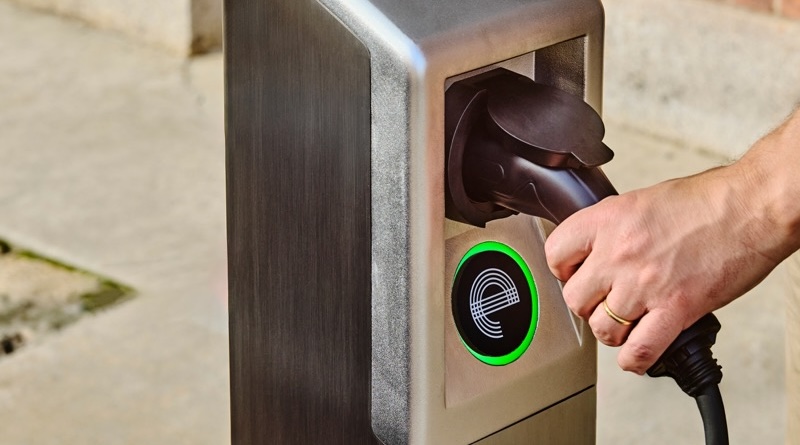
New York City officials announced plans to deploy 600 new Level 2 curbside electric vehicle charging stations, expanding the city's street-accessible EV infrastructure nearly sevenfold from its current footprint of 88 units.
The expansion addresses a persistent barrier to EV adoption in dense urban environments where off-street parking remains scarce. Apartment dwellers and street parkers without dedicated garages face the most acute charging constraints, limiting their ability to switch from combustion vehicles. Level 2 chargers deliver approximately 25 miles of range per hour, making them suitable for overnight or extended parking periods typical in residential neighborhoods.
New York City's transportation sector accounts for roughly 27 percent of the city's total greenhouse gas emissions, according to the city's own climate data. The five boroughs currently host more than 1 million registered vehicles, with electric vehicle registrations climbing steadily. As of 2024, EVs comprised roughly 4 percent of new vehicle registrations across the city, up from under 2 percent three years prior. Scaling curbside infrastructure directly enables this transition by removing a primary obstacle for residents considering EV purchases.
The 600-station deployment represents a response to recommendations from the city's Department of Environmental Protection and the Office of Long-Term Planning and Sustainability. These agencies have flagged charging access as essential to meeting New York's 2050 climate neutrality goal. The city committed to achieving 100 percent zero-emission vehicle sales by 2035 as part of its Climate Mobilization Act, passed in 2019.
The specific timeline and funding mechanism for this expansion remain under development. Previous curbside charging rollouts in other major cities including San Francisco, Los Angeles, and Washington DC have faced logistical hurdles. Identifying suitable locations on congested streets, managing electrical grid capacity at distribution points, and preventing charging spot blockage by non-charging vehicles have all posed implementation challenges. San Francisco's Envirotech program initially planned to install 2,000 Level 2 chargers but progressed slower than projected due to utility coordination and installation costs.
New York City has established partnerships with private charging networks including ChargePoint and Plug America to expand its public charging ecosystem. The curbside expansion complements existing DC fast-charging hubs at municipal lots and commercial facilities, which serve longer-range trips and transit hubs.
The city faces competing demands for limited curb space, balancing EV charging deployment against bike lanes, bus lanes, loading zones, and street parking. The Department of Transportation will need to coordinate site selection with community boards across all five boroughs to minimize disruptions to existing parking supply while prioritizing underserved neighborhoods with lower vehicle ownership rates and higher apartment density.
Success metrics will likely include charging utilization rates, EV adoption correlations in areas with new infrastructure, and grid reliability assessments. Cities including Seattle and Denver have used similar deployment data to inform second-phase rollout planning.