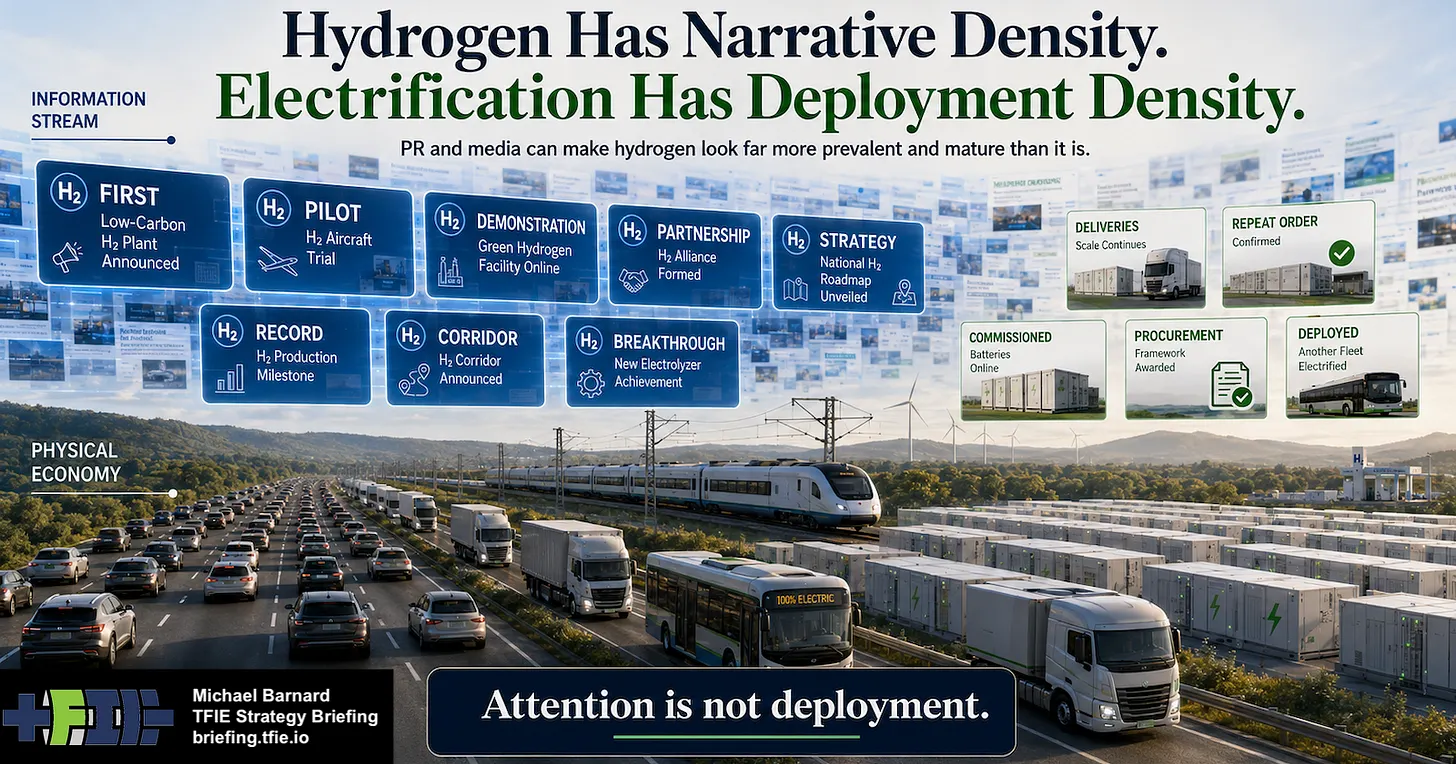
Hydrogen captures outsized media attention relative to its actual role in global decarbonization efforts, creating a misleading narrative about its deployment trajectory and near-term climate impact.
The gap between hydrogen's news presence and its physical infrastructure reveals a fundamental disconnect in energy transition reporting. Pilot projects, demonstration programs, and corporate announcements dominate coverage while actual deployed capacity remains minimal. Fuel-cell trucks, buses, trains, and storage facilities generate recurring headlines through corporate releases and government statements, yet these announcements vastly outnumber operational installations delivering measurable emissions reductions.
This coverage imbalance stems partly from hydrogen's appeal to incumbent energy companies and industrial players seeking to maintain relevance in a decarbonizing economy. Existing fossil fuel infrastructure providers, petrochemical manufacturers, and traditional energy firms have strong incentives to promote hydrogen as a credible climate solution. Such promotion requires minimal actual deployment. Strategic announcements and pilot programs generate positive media coverage without requiring massive capital commitments or fundamental business model changes.
The International Energy Agency and other research institutions have clarified hydrogen's realistic role in net-zero pathways. Hydrogen serves specific industrial purposes: ammonia production, steel manufacturing, and certain hard-to-decarbonize chemical processes. These applications represent roughly 2 percent of global energy demand. For transportation and heating, direct electrification outperforms hydrogen on efficiency grounds. Battery electric vehicles convert 70 to 80 percent of grid electricity into motion, while hydrogen pathways lose 30 to 50 percent of energy through production, compression, and conversion losses.
Current hydrogen deployment figures support this assessment. Global installed hydrogen production capacity remains under 100 million tonnes annually, with roughly 95 percent generated from natural gas and coal through steam methane reforming. This process emits approximately 830 million tonnes of carbon dioxide yearly. Green hydrogen produced through electrolysis using renewable electricity represents less than 1 percent of total supply. Cost curves for green hydrogen have improved but remain uncompetitive without sustained policy support.
The media narrative problem extends beyond proportionality. Coverage often conflates different hydrogen categories without clarity, treating gray hydrogen generated from fossil fuels similarly to green hydrogen from renewables. This creates public confusion about hydrogen's actual climate benefits. A fuel-cell bus announcement gains prominent placement without acknowledging whether it runs on gray or green hydrogen, obscuring the emissions question entirely.
Policy environments amplify this dynamic. Governments in the European Union, Japan, South Korea, and Australia have invested substantially in hydrogen development strategies. These public commitments trigger corporate announcements and media coverage. Australia allocated $2 billion toward hydrogen infrastructure despite minimal current demand. The EU's hydrogen strategy targets 10 million tonnes of green hydrogen production by 2030, a figure requiring five times the current global renewable electrolysis capacity.
The attention-deployment gap raises serious concerns about transition strategy allocation. Resources flowing toward hydrogen demonstration projects represent opportunity costs. Capital directed toward hydrogen infrastructure could accelerate deployment of proven technologies. Battery manufacturing expansion, grid modernization, and renewable energy deployment offer faster emissions reductions and clearer pathways to net-zero targets.
This does not eliminate hydrogen's future relevance. Industrial decarbonization will require hydrogen for specific applications. Green hydrogen production will grow. The concern centers on present misallocation of attention and resources driven by corporate interests and policy enthusiasm rather than deployment realities.