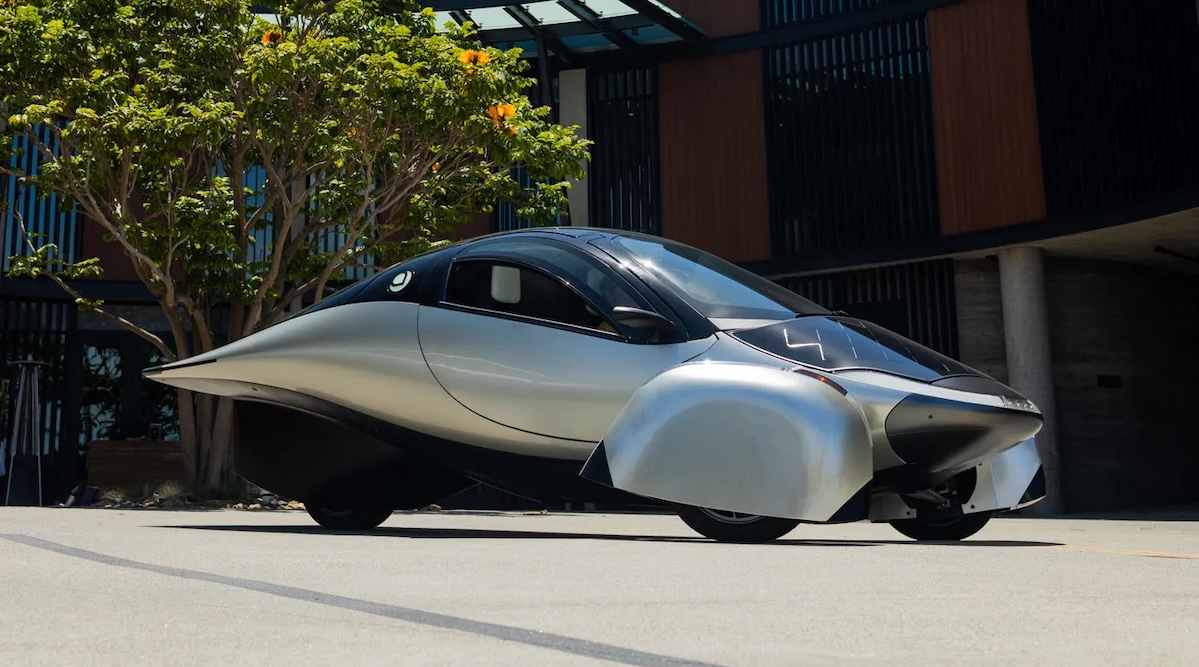
Aptera Motors has begun delivering electric vehicles equipped with integrated solar panels that generate sufficient power for approximately 40 miles of daily driving under typical conditions. The solar-equipped EVs carry battery packs capable of extending range to 1,000 miles per charge, combining photovoltaic technology with conventional battery storage.
The vehicles' aerodynamic design plays a central role in the solar integration strategy. Aptera engineered the cars with minimal drag coefficients, reducing energy consumption and allowing solar panels mounted on the roof and hood to contribute meaningfully to overall propulsion. This approach addresses a persistent engineering challenge: solar panels on conventional vehicles typically generate insufficient power for practical daily use because conventional car shapes waste energy fighting air resistance.
The Aptera qualifies for California High-Occupancy Vehicle lane access, a designation reserved for zero-emission and plug-in hybrid vehicles meeting efficiency thresholds. California's HOV eligibility criteria require vehicles to achieve specific fuel economy standards measured in miles per gallon equivalent. Aptera's efficiency metrics exceeded those benchmarks, reflecting both the solar contribution and the streamlined design's energy advantages.
Solar-powered vehicles have remained largely theoretical outside niche applications because standard automotive shapes dissipate energy inefficiently. Previous attempts at solar integration produced minimal range gains. Aptera's design philosophy reverses this approach by optimizing the entire vehicle platform around aerodynamics first, then layering solar capability onto an already efficient foundation.
The production timeline remains critical. Aptera announced the vehicles would reach customer deliveries in 2026, marking one of the first commercially available solar EVs developed specifically for mass production rather than prototype demonstration. The 40-mile daily solar range assumes average sunlight conditions without premium solar panel efficiency improvements likely arriving within the vehicle's production cycle.
This convergence of solar technology, aerodynamic engineering, and battery density advances removes a primary obstacle that blocked solar EV