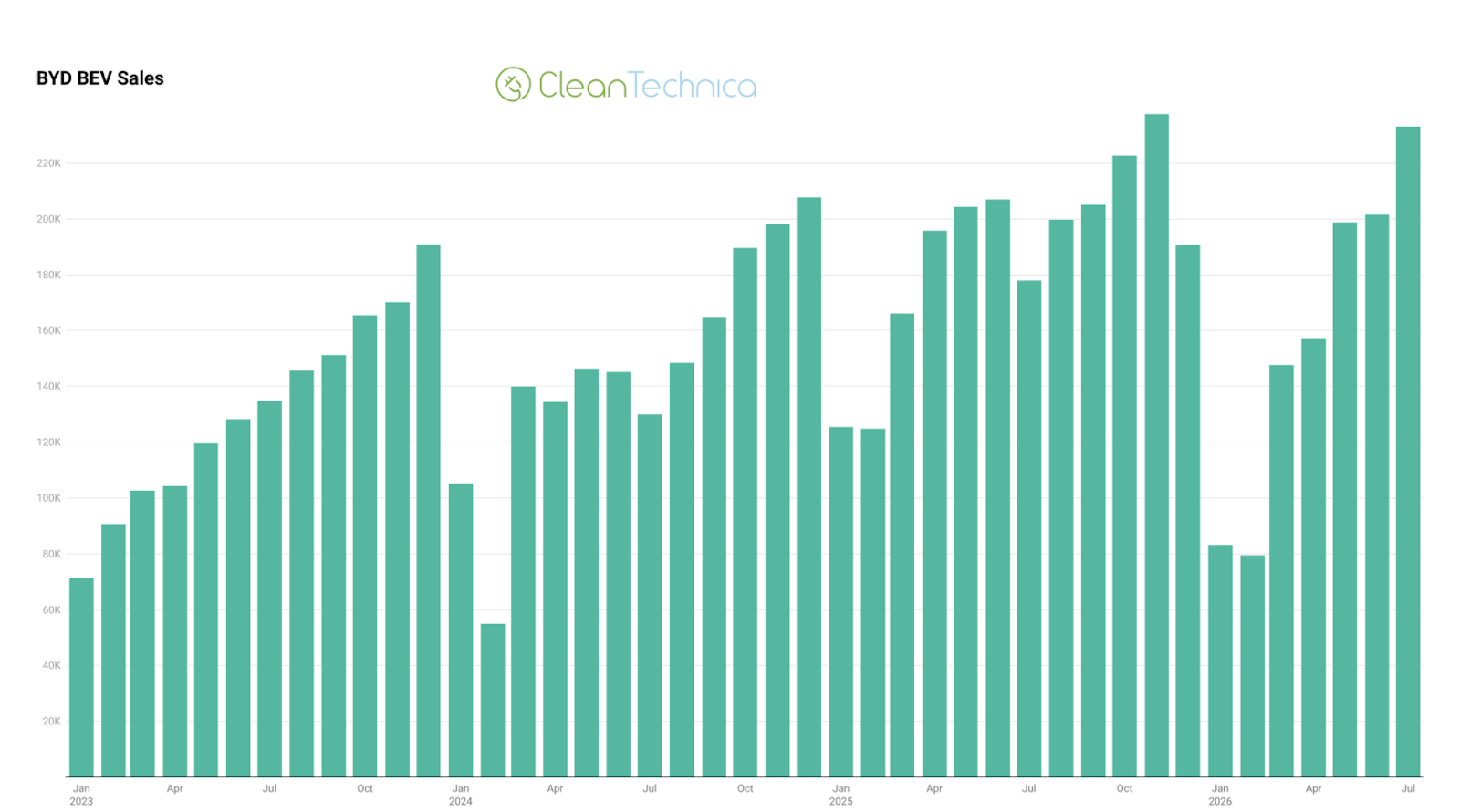
BYD sold 411,072 battery electric vehicles in July 2026, marking a 31% increase in BEV sales specifically and a 20.5% rise in total passenger vehicle sales compared to July 2025, when the company moved 341,030 units. The world's largest EV manufacturer posted 3.5% growth from June 2026, signaling accelerating momentum after a sluggish start to the year.
The production surge reflects BYD's expanding market dominance in the global EV transition. The company's July performance demonstrates sustained consumer demand for electric vehicles even as competition intensifies across Asia, Europe, and North America. BYD manufactures both battery electric vehicles and plug-in hybrids, though the BEV-specific growth outpaced overall passenger vehicle gains.
The Chinese automaker faces mounting pressure from competitors including Tesla, NIO, and traditional manufacturers pivoting to electrification. July's results suggest BYD's pricing strategy, battery supply chain advantages, and model lineup diversification are resonating with buyers. The company controls substantial battery production capacity, giving it cost advantages over rivals.
Global EV adoption continues reshaping transportation markets. BYD's sales volume positions it as a bellwether for broader industry trends. Analysts track monthly unit sales as indicators of demand strength, manufacturing capacity utilization, and consumer confidence in electric vehicle technology. The 31% year-over-year BEV growth outpaces the broader EV market expansion in most developed economies.
BYD's performance matters for carbon emissions calculations. Each additional EV sale displaces gasoline-powered vehicles, reducing tailpipe emissions and demand for petroleum. In China, where grid electricity increasingly comes from wind and solar generation, EV adoption delivers larger emissions reductions than in coal-dependent regions. BYD's July sales contribute measurable decreases to