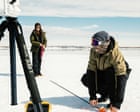
Arctic sea ice melting has accelerated to levels outpacing even worst-case climate models from a decade ago. Scientists working in Cambridge Bay, northern Canada, are exploring geoengineering approaches to refreeze summer ice as conventional emissions reduction alone fails to reverse the trend.
The summer melt represents the most visible consequence of global warming in polar regions. Arctic sea ice extent has declined roughly 13 percent per decade since the 1970s, according to satellite records maintained by the National Snow and Ice Data Center. This loss destabilizes regional ecosystems, disrupts Indigenous communities dependent on stable ice conditions, and weakens the polar amplification feedback loop that moderates global temperatures.
Researchers stationed in Cambridge Bay observe ice collapse occurring weeks earlier than historical baselines. The brilliant white surface reflects solar radiation back to space. When that reflective ice vanishes, the darker ocean absorbs additional heat, accelerating melt in a self-reinforcing cycle.
Geoengineering proposals under consideration include brightening sea ice through reflective particles or altering cloud formations to increase surface albedo. These interventions remain experimental and carry unknown ecological consequences. No peer-reviewed studies demonstrate scalable deployment at meaningful climate impact.
The research reflects desperation born from arithmetic. Limiting Arctic warming to 1.5 degrees Celsius above preindustrial levels requires global emissions cuts of roughly 45 percent by 2030. Current trajectories point toward 2.7 degrees of warming by century's end under existing climate policies, according to United Nations Environment Programme analysis.
Arctic scientists view geoengineering not as a replacement for emissions reduction but as a potential complement. The ice melt threatens cascading disruptions. Loss of sea ice habitat jeopardizes polar bears, seals, and walrus populations. Melting permafrost releases methane and carbon dioxide stored for millennia. Indigenous