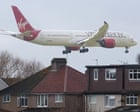
The Department for Transport's official analysis reveals that constructing a third runway at London's Heathrow Airport would inflict significant adverse health effects on up to 3 million nearby residents.
The report, commissioned by the DfT, identifies "major adverse" health impacts concentrated among the most local population. The expansion threatens access to housing, education, healthcare, open spaces and transport infrastructure for communities surrounding the airport.
Air quality degradation represents a primary concern. The third runway would increase aircraft movements substantially, amplifying emissions of nitrogen oxides and particulate matter in surrounding neighborhoods. Residents already experiencing elevated pollution levels from existing operations would face further deterioration in respiratory and cardiovascular health outcomes.
Noise pollution extends the health burden. Aircraft noise directly correlates with sleep disruption, stress-related illness and hypertension. The additional runway intensifies flight paths over densely populated areas, keeping ambient noise levels elevated throughout night hours when mitigation becomes difficult.
The analysis flags secondary health pathways. Expansion-related construction disrupts local transportation networks, limiting residents' access to medical facilities. Property values in affected zones decline, reducing household wealth and limiting healthcare quality accessible to lower-income families. Loss of green spaces removes exercise opportunities and mental health refuges that buffer urban populations from pollution stress.
Healthcare services themselves face strain. Increased demand for respiratory and cardiovascular treatment outpaces facility capacity in outer London boroughs. Educational outcomes suffer when students endure chronic noise exposure, affecting long-term health trajectories through reduced academic achievement and employment prospects.
The government has initiated fast-track planning procedures to advance the expansion despite these health findings. This procedural acceleration compresses public consultation periods and environmental review timelines, limiting community input and independent scrutiny.
The DfT analysis quantifies the trade-offs: expanded aviation capacity and economic activity against measurable population health burden concentrated in neighborhoods with limited political leverage. No equivalent analysis presents mit